

Geopolitical and trade uncertainty, along with growing expectations that the US Federal Reserve will keep interest rates elevated for an extended period, continue to weigh on the digital asset sector in the longer term. In particular, the risk of escalation in the US–Iran conflict remains in the Middle East, with both sides preparing for potential military action despite ongoing negotiations over Iran’s nuclear program. Analysts believe that a deterioration in the situation could lead to significant disruptions in energy supplies from the region and, as a result, a sharp rise in oil prices, which in some scenarios could reach $150 per barrel, significantly slowing the global economic recovery.
In addition, investors are concerned about the future foreign policy stance of the White House and the potential cancellation of previously signed agreements, after President Donald Trump announced over the weekend the introduction of new 15.0% import tariffs on all trading partners. Economic instability is pushing market participants toward defensive assets, a role cryptocurrencies have yet to assume. At the same time, maintaining the current Fed policy at least until mid-year appears increasingly likely, supporting the US dollar. It is worth recalling that in January the labor market showed a decline in unemployment to 4.3%, while inflation slowed to 2.4%, still above the regulator’s target and remaining elevated in several key consumer sectors.
An additional source of pressure on XRP has come from a large token transfer to the Binance exchange, as such moves are typically associated with planned asset sales. According to estimates by analytics provider CryptoQuant, 31.0 million XRP were sent to the platform over the weekend, with the highest activity coming from wallets holding more than 1.0 million XRP. At the same time, moderate inflows into digital exchange-traded funds have resumed, with Ripple ETFs recording $2.25 million in inflows yesterday. However, the Fear & Greed Index remains in the “extreme fear” zone at a reading of 11. Investor interest in cryptocurrencies could be strengthened by approval of the CLARITY crypto market structure bill, but according to Ripple CEO Brad Garlinghouse, this is unlikely to happen before the end of April.
Support and Resistance Levels
The instrument is moving within a descending channel and is attempting to consolidate below 1.3671 (Murray level [3/8]). If successful, the decline could resume toward targets at 0.9765 (Murray level [1/8]) and 0.7812 (Murray level [0/8]). However, a consolidation above the resistance zone at 1.5625–1.6420 (Murray level [4/8], Fibonacci retracement 61.8%) would signal a potential trend reversal and open the way for growth toward 1.9531 (Murray level [6/8]) and 2.3437 (Murray level [8/8], Fibonacci retracement 38.2%).
Technical indicators provide mixed signals: Bollinger Bands are flattening, the MACD histogram remains stable in negative territory, and the Stochastic oscillator is moving sideways near oversold levels. In addition, on the weekly chart, Bollinger Bands are trending downward, confirming the persistence of a long-term bearish trend.
Resistance levels: 1.6420, 1.9531, 2.3437.
Support levels: 1.3671, 0.9765, 0.7812.
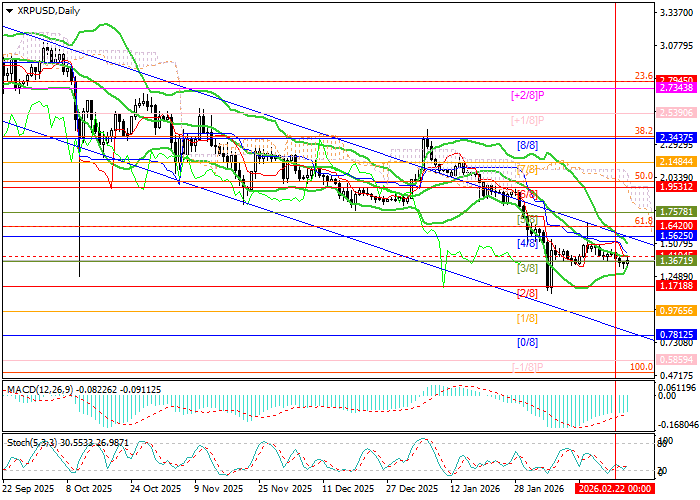
Trading Scenarios and XRP/USD Forecast
Short positions can be opened below 1.3671 with targets at 0.9765 and 0.7812, and a stop-loss at 1.5700. Time horizon: 5–7 days.
Long positions can be opened above 1.6420 with targets at 1.9531 and 2.3437, and a stop-loss at 1.4200.
Scenario
| Timeframe | Weekly |
| Recommendation | SELL STOP |
| Entry point | 1.3220 |
| Take Profit | 0.9765, 0.7812 |
| Stop Loss | 1.5700 |
| Key levels | 0.7812, 0.9765, 1.3671, 1.6420, 1.9531, 2.3437 |
Alternative Scenario
| Recommendation | BUY STOP |
| Entry point | 1.6500 |
| Take Profit | 1.9531, 2.3437 |
| Stop Loss | 1.4200 |
| Key levels | 0.7812, 0.9765, 1.3671, 1.6420, 1.9531, 2.3437 |