
On Monday, European Central Bank (ECB) President Christine Lagarde said during a conference in Washington that the current interest rate configuration is “in a good place” and consistent with the eurozone’s macroeconomic conditions. According to her, inflation has slowed significantly from its 2022 peak, when it exceeded 10.0% year-on-year, and is now hovering around the 2.0% target. Lagarde noted that the current level of borrowing costs provides sufficient monetary tightness to bring consumer price growth back toward projected levels in the medium term. At the same time, she pointed out that economic activity remains subdued, although GDP growth accelerated to 0.3% quarter-on-quarter and 1.3% year-on-year in the fourth quarter, according to preliminary estimates, while the labor market remains relatively resilient, with unemployment holding near 6.2%, close to historical lows. She emphasized that the Governing Council will continue to base its decisions on incoming macroeconomic data, assessing inflation dynamics, wage growth, and the transmission of monetary policy to the real economy.
Against this backdrop, the January inflation report will be key for policymakers and is due to be released today at 12:00 (GMT+2). According to preliminary forecasts, inflation may decline by 0.5% month-on-month after a 0.2% increase previously, while the annual rate could fall from 1.9% to 1.7%, below the 2.0% target. As for core CPI, which excludes food and energy prices, it is expected to post a monthly increase of 2.3% and ease to 2.2% year-on-year. If analysts’ expectations are confirmed, this would provide additional support for the ECB’s current stance and increase the likelihood of a shift back toward a more dovish policy.
As for the key factor shaping EUR/USD dynamics—the US dollar—its quotes remain near 97.6 points in the USDX during the morning session, extending bullish momentum after the US Supreme Court ruled last Friday that the 10.0% import tariffs initiated by Donald Trump were unlawful, as the president lacked authority to invoke the International Emergency Economic Powers Act (IEEPA) without congressional approval. In response, the US leader announced a new adjustment, raising tariffs from 10.0% to 15.0% for all countries under the Trade Act of 1974. Against this backdrop, the European Parliament said it intends to suspend legislative work on approving a trade agreement with the United States. According to Bernd Lange, chair of the Committee on International Trade, the “customs chaos” and growing uncertainty from the Republican administration undermine confidence in the implementation of existing agreements and require time for a comprehensive legal assessment.
Support and resistance levels
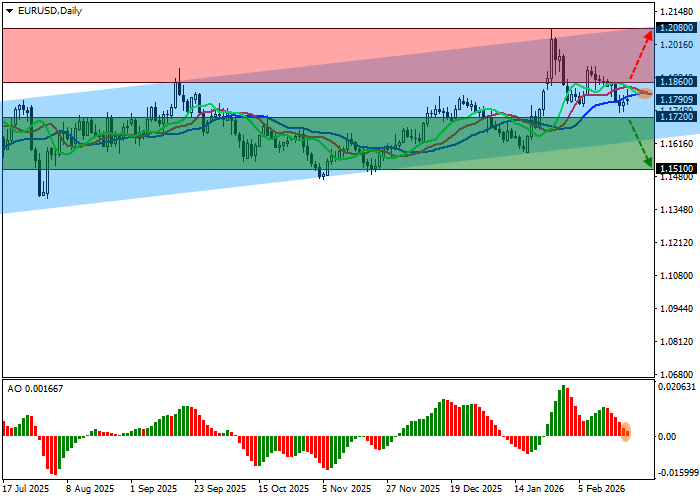
On the daily chart, the instrument is attempting to approach the support line of the ascending channel at 1.2150–1.1630.
Technical indicators have not yet reversed but have noticeably weakened the buy signal formed in late January: the fast EMAs on the Alligator indicator are holding slightly above the signal line while continuing to narrow their range, and the AO histogram is forming new corrective bars while remaining in positive territory.
Support levels: 1.1720, 1.1510.
Resistance levels: 1.1860, 1.2080.
Trading scenarios and EUR/USD outlook
Short positions may be opened after the price consolidates below 1.1720, with a target at 1.1510. Stop-loss: 1.1820. Time horizon: 7 days or more.
Long positions may be opened after the price consolidates above 1.1860, with a target at 1.2080. Stop-loss: 1.1780.
Scenario
| Timeframe | Weekly |
| Recommendation | SELL STOP |
| Entry point | 1.1715 |
| Take Profit | 1.1510 |
| Stop Loss | 1.1820 |
| Key levels | 1.1510, 1.1720, 1.1860, 1.2080 |
Alternative scenario
| Recommendation | BUY STOP |
| Entry point | 1.1865 |
| Take Profit | 1.2080 |
| Stop Loss | 1.1780 |
| Key levels | 1.1510, 1.1720, 1.1860, 1.2080 |