

As a reminder, the nationwide consumer price index declined from 2.1% to 1.5% year-on-year, falling below the Bank of Japan’s 2.0% target, while the core indicator eased from 2.4% to 2.0%, reaching a two-year low. This dynamic may hinder plans for further increases in borrowing costs. At the same time, the national economy showed signs of improvement in the fourth quarter: gross domestic product (GDP) rose by 0.1% quarter-on-quarter after contracting by 0.7%, formally avoiding a technical recession. However, the actual figure came in well below the Reuters consensus forecast of 0.4%. On an annual basis, GDP grew by 0.2% versus preliminary estimates of 1.6%, following a revised decline of 2.3% previously, while year-on-year growth slowed from 0.6% to 0.1%. The key driver of the gradual recovery was stronger private consumption, which partially offset weak exports and reduced government spending. Nevertheless, the GDP structure points to limited resilience in domestic demand and a continued dependence on external conditions, shaping a restrained fundamental backdrop for the yen. Meanwhile, in January the Bank of Japan revised its economic growth forecast for the fiscal year ending in March from 0.7% to 0.9%, and for fiscal year 2026 from 0.7% to 1.0%, confirming expectations of gradual stabilization supported by a positive inflation trajectory and wage indexation amid government stimulus measures. In parallel, Japanese authorities are actively engaging with the Republican administration in the White House — the country’s second-largest trading partner — within the framework of a $550.0 billion investment commitment stipulated by bilateral agreements.
In addition, Japanese investors focused on a report published by the International Monetary Fund (IMF) on February 17, which outlined three key recommendations. First, experts stressed the critical importance of preserving the independence of the Bank of Japan to maintain confidence in monetary policy and anchor inflation expectations — a stance interpreted as indirect support for further policy tightening despite potential political pressure. They also warned the government against expanding fiscal policy, noting that Japan’s public debt remains the largest among advanced economies and that debt servicing costs are expected to double by 2031 as existing liabilities are refinanced at higher rates. Third, the IMF explicitly opposed Prime Minister Sanae Takaichi’s proposal to suspend the 8.0% consumption tax on food for two years, calling the measure an “untargeted stimulus” that would reduce fiscal space without providing targeted support to vulnerable households.
Support for the US dollar came from personal consumption expenditures (PCE) data for December, which showed the annual rate accelerating from 2.8% to 3.0% versus preliminary estimates of 2.9%, and the monthly figure rising from 0.2% to 0.4% compared with expectations of 0.3%. The core indicator was revised higher as well, from 2.8% to 2.9% year-on-year and from 0.2% to 0.4% month-on-month. Meanwhile, initial jobless claims for the week fell from 229.0K to 206.0K, below forecasts of 223.0K; the four-week average edged down from 220.0K to 219.0K, while continuing claims stood at 1.869 million versus 1.860 million previously. These figures support the Federal Reserve’s wait-and-see stance on interest rate adjustments. Currently, the CME FedWatch Tool assigns a 95.5% probability that rates will remain in the 3.50–3.75% range at the March 18 meeting.
Support and resistance levels
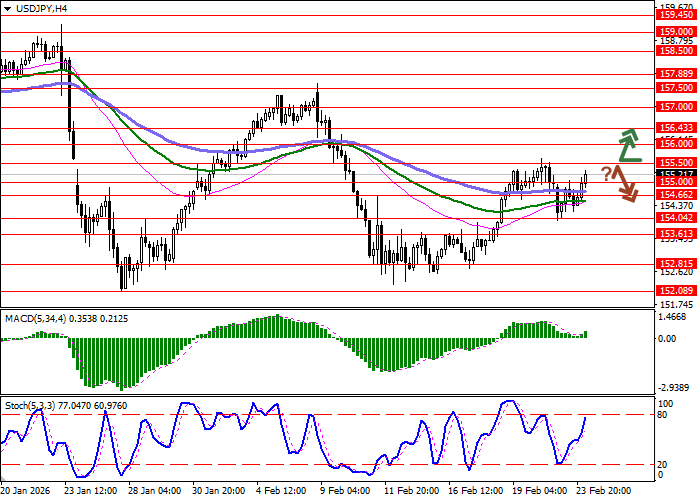
On the daily chart, Bollinger Bands show a moderate decline: the price range is narrowing from the upper side while remaining sufficiently wide for the current level of activity. The MACD is rising, maintaining a relatively strong bullish signal as the histogram stays above the signal line. The Stochastic oscillator, having retreated from its recent highs earlier this week, is flattening again in response to a resumption of upward momentum.
Resistance levels: 155.50, 156.00, 156.43, 157.00.
Support levels: 155.00, 154.66, 154.04, 153.61.
Trading scenarios and USD/JPY forecast
Long positions may be considered after a confident breakout above 155.50, with a target at 156.43 and a stop-loss at 155.00. Time horizon: 1–2 days.
A rebound from 155.50 as resistance followed by a break below 155.00 could signal an opportunity to open short positions targeting 154.04. Stop-loss at 155.50.
Scenario
| Timeframe | Intraday |
| Recommendation | BUY STOP |
| Entry point | 155.55 |
| Take Profit | 156.43 |
| Stop Loss | 155.00 |
| Key levels | 153.61, 154.04, 154.66, 155.00, 155.50, 156.00, 156.43, 157.00 |
Alternative scenario
| Recommendation | SELL STOP |
| Entry point | 154.95 |
| Take Profit | 154.04 |
| Stop Loss | 155.50 |
| Key levels | 153.61, 154.04, 154.66, 155.00, 155.50, 156.00, 156.43, 157.00 |