

Bitcoin is trading today near $86,053.19, down 2.42% over the past 24 hours. Ethereum (ETH/USD) is hovering around $2,941.29 (–3.91%), while XRP (XRP/USD) has slipped to $1.88804, posting a 4.64% daily loss.
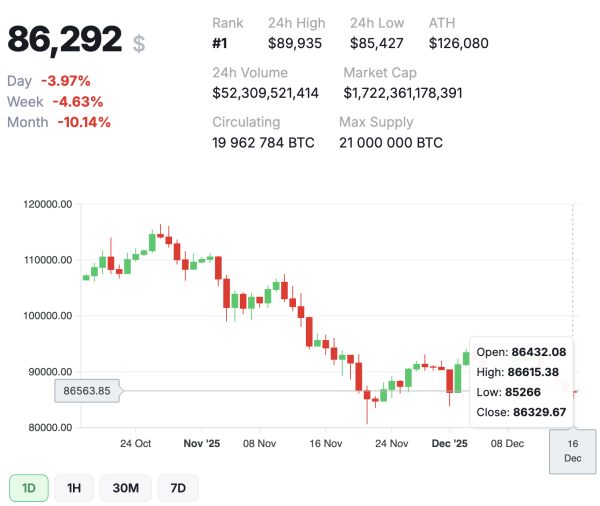
Over the past two days, the Bitcoin market has gone through a sharp correction. At the time of writing, BTC is trading near $86,000, down more than 5% on the week. The sell-off accelerated after the price failed to hold above the $90,000–$92,000 zone, triggering a wave of long liquidations and a rapid deterioration in market sentiment.
Derivative market data show that nearly $200 million in leveraged long positions were liquidated once Bitcoin broke below $87,000. This highlights how thin weekend liquidity combined with elevated leverage amplified the downside move.
At the same time, market participants note that the liquidation cascade remained orderly, with no signs of panic selling. Price action is still contained within a broader $85,000–$94,000 trading range.
Japan Factor and the Carry Trade Unwind
One of the key drivers behind the current weakness is rising expectations of a Bank of Japan (BoJ) rate hike at the upcoming policy meeting. Markets are assigning a probability above 90% that the central bank will tighten policy for the first time in years.
Such a move strengthens the yen and forces investors to unwind yen-funded carry trades — strategies that relied on cheap borrowing in yen to invest in higher-risk assets, including cryptocurrencies. Historically, previous BoJ rate hikes have coincided with 20–30% declines in Bitcoin, as traders rushed to sell assets to repay yen-denominated loans.
This time, the process appears to have started early, leading to pre-emptive risk reduction across global markets. Pressure has been compounded by weakness in technology stocks and by expectations for U.S. rate cuts being pushed out to 2026.
Bitcoin Outlook for December 17
Macro stress is also visible in on-chain and derivatives data. Over the past 24 hours, $125–200 million in long liquidations were recorded, while total crypto market liquidations reached approximately $293 million.
Market reports suggest that market maker Wintermute sold around $1.5 billion worth of Bitcoin to rebalance risk, adding further downside pressure. With shallow order books following October’s flash crash and November’s correction, even a moderate wave of sell orders was enough to push prices sharply lower.
Analysts describe the current environment as a market defined by low volumes, choppy price action, and a lack of conviction, where rallies are consistently sold into by investors who entered near the October highs.
Sentiment indicators confirm this picture: the Fear & Greed Index has fallen into the low 20s, signalling a state of extreme fear.
Key Levels and Scenarios
In the short term, traders are focused on the following levels:
- $88,000 — immediate support
- A breakdown could expose $82,000–$77,000
- Some technical models even allow for a test of $70,000 if the BoJ delivers a more aggressive hike than expected
On the upside, a reclaim of the $90,000–$91,000 zone could help stabilise sentiment and trigger short covering toward $95,000.
Daily RSI and MACD indicators remain weak, pointing to ongoing downside risks. However, oversold conditions and continued institutional inflows into spot Bitcoin ETFs suggest that long-term demand remains intact.
Strong inflows into regulated funds and recent corporate purchases further confirm sustained interest from large players despite elevated volatility.
What Comes Next?
Heading into the final full trading week of December, macro events will be decisive for Bitcoin’s near-term trajectory. The Bank of Japan’s decision, followed by U.S. inflation data and Federal Reserve commentary, will shape liquidity expectations heading into early 2026.
Until greater clarity emerges, investors should be prepared for sharp swings, respect support zones at $85,000 and $82,000, and closely monitor any attempts to regain territory above $90,000.
In the current environment, patience and disciplined risk management remain essential for navigating the market.