

The RBA’s report notes that Board members considered various scenarios involving a potential interest-rate increase in 2026. Recall that the policy rate was previously held at 3.60%, while officials pointed to the need for a longer period of stable monetary conditions amid accelerating domestic inflation, which according to the latest data exceeds 4.0% year-on-year, as well as persistent tightness in the labor market with unemployment around 3.8%. These factors were among the reasons behind the current pause in adjusting parameters, especially given that over the course of the year the RBA reduced the interest rate by a total of 75 basis points. Despite discussing scenarios of possible tightening next year, the regulator concluded that it is still premature to draw final conclusions about the sustainability of the inflation upturn, preferring to maintain a wait-and-see stance in the near term until clearer signals emerge from macroeconomic data. The RBA also noted that if moderately restrictive financial conditions are maintained and there is confirmation that the observed price pressure is temporary, holding borrowing costs at the current level for some time may be sufficient to keep the economy in balance.
Meanwhile, the Australian government sharply criticized China’s Ministry of Commerce decision to impose a 55.0% tariff on beef imports, calling the move a “blow” to local producers. In 2026, the threshold will be set at 2.7 million metric tons, while the “safeguard measures” will remain in place for at least three years and the quotas will be increased annually. According to the Chinese government, the changes are intended to address the growing volume of imports, which has caused serious damage to domestic industry. The changes could reduce Australia’s beef exports to China by roughly one-third compared with last year; trade volume had exceeded 1.0 billion Australian dollars, the statement said.
In the United States, the decision to cut the key rate at the December 9–10 meeting was approved by a slim margin (nine members of the Federal Open Market Committee (FOMC) voted for a 25-basis-point cut, while three opposed). The discussion itself points to a lack of consensus within the Fed, which is forced to balance continued cooling in the labor market against persistent inflationary pressure. Particular attention was paid to the impact of trade policy. Participants acknowledged that tariffs introduced by the administration of U.S. President Donald Trump are contributing to higher prices, but generally agreed that this effect is temporary and will fade by 2026. Nevertheless, for some officials this factor became an additional argument in favor of caution regarding further rate cuts.
Tomorrow at 16:45 (GMT+2), traders will focus on U.S. December services-sector business activity data. If the reading rises from the current 52.9 points, it would support the U.S. dollar.
Support and Resistance Levels
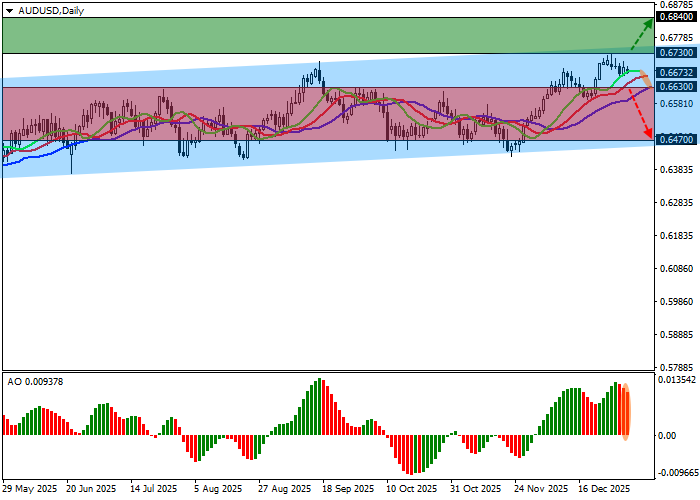
On the daily chart, the pair is trading within an ascending channel with dynamic boundaries of 0.6800–0.6450.
Technical indicators have long since turned higher and maintain a renewed buy signal that is actively strengthening: the fast EMAs in the Alligator indicator are again positioned above the signal line, widening the fluctuation range, while the AO oscillator histogram is increasing in the buying zone.
Support levels: 0.6630, 0.6470.
Resistance levels: 0.6730, 0.6840.
Trading Scenarios and AUD/USD Forecast
Long positions should be opened after the price consolidates above the 0.6730 resistance level with a target at 0.6840. Stop-loss — 0.6650. Time horizon: 7 days or more.
Short positions should be opened after the price consolidates below the 0.6630 support level with a target at 0.6470. Stop-loss — 0.6710.
Scenario
| Timeframe | Weekly |
| Recommendation | BUY STOP |
| Entry point | 0.6730 |
| Take Profit | 0.6840 |
| Stop Loss | 0.6650 |
| Key levels | 0.6470, 0.6630, 0.6730, 0.6840 |
Alternative scenario
| Recommendation | SELL STOP |
| Entry point | 0.6630 |
| Take Profit | 0.6470 |
| Stop Loss | 0.6710 |
| Key levels | 0.6470, 0.6630, 0.6730, 0.6840 |