
In addition, labour market data will be released: analysts expect a moderate increase in the number of unemployed by 2.0 thousand in January after flat dynamics in the previous month, while the seasonally adjusted unemployment rate is likely to remain around 6.3%. Earlier, investors focused on Germany’s fourth-quarter GDP report, which showed growth of 0.3% quarter-on-quarter and 0.4% year-on-year, in line with market expectations. Meanwhile, March consumer climate data from the GfK Group — an indicator reflecting confidence in economic strength and a leading signal for household spending — pointed to an acceleration in negative sentiment, with the index falling from –24.2 to –24.7 points. Commenting on the data, Rolf Bürkl, analyst at the Nuremberg Institute for Market Decisions, noted that consumers remain pessimistic and are more inclined to channel funds into savings amid rising geopolitical uncertainty rather than increase spending.
At the same time, ECB President Christine Lagarde, speaking before the European Parliament committee, confirmed that monetary authorities’ efforts to combat inflation have proven effective: consumer price growth is steadily converging toward the 2.0% target over the medium term as wage growth gradually slows, while the region’s economic potential remains strong despite new constraints from the White House. According to her, the trade environment remains challenging due to changes in tariffs, euro strength, and ongoing global political volatility. Recall that after the US Supreme Court ruled that the 10.0% import tariffs initiated by Donald Trump were unlawful and that he lacked authority to apply the International Emergency Economic Powers Act (IEEPA) without congressional approval, the US president announced an adjustment of the tariff rate from 10.0% to 15.0% for all countries, this time under the Trade Act of 1974. Recently published consumer and business confidence data further intensified concerns: the indicator came in at 99.3 points versus expectations of 99.8, while the services expectations index fell from 7.2 to 5.0 points in February (against a forecast of 7.5), and the business climate index edged down from –0.38 to –0.36 points.
Later today at 15:30 (GMT+2), US investors and forex traders will focus on the producer inflation report. Current projections suggest a slowdown in the annual rate from 3.0% to 2.6%, reinforcing expectations of a potential Federal Reserve rate cut in the second half of the year, while the monthly figure is expected to ease from 0.5% to 0.3%. Earlier this week, Kansas City Fed President Jeffrey Schmid stated that price pressures remain the key challenge for the regulator, though he did not specify when or how monetary policy adjustments should be made. He reiterated his scepticism toward lowering borrowing costs, arguing that the fight against inflation is not yet complete and cautioning against relying on productivity gains or artificial intelligence as immediate solutions. Atlanta Fed President Raphael Bostic added that political pressure on the central bank undermines public confidence in its independence, which could ultimately weaken the US dollar’s status as a safe-haven currency.
Support and resistance levels Forecast
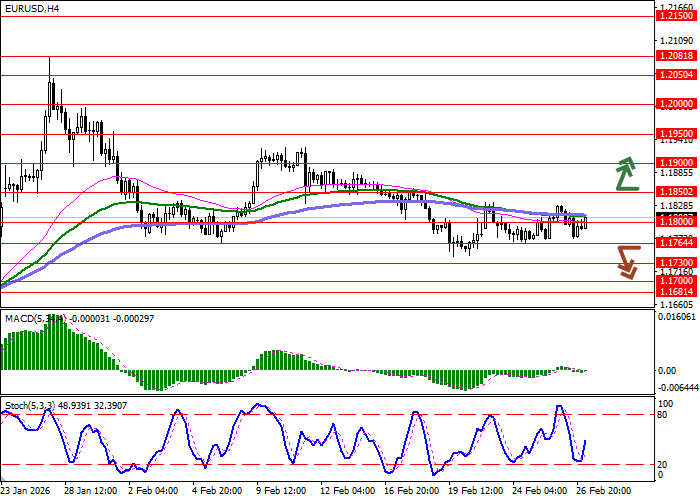
On the daily chart, Bollinger Bands are sloping downward, with the price range narrowing while still leaving room for current activity. The MACD is turning higher, generating a fresh buy signal as it attempts to move above the signal line and the zero level. The Stochastic oscillator shows a similar trajectory, though its line is rapidly approaching the 80 mark, pointing to rising overbought risks for the euro in the very short term.
Resistance levels: 1.1800, 1.1850, 1.1900, 1.1950.
Support levels: 1.1764, 1.1730, 1.1700, 1.1681.
Trading scenarios and EUR/USD outlook
Long positions may be considered after a confident upside breakout above 1.1850, targeting 1.1950. Stop-loss: 1.1800. Time horizon: 2–3 days.
A return of bearish momentum followed by a downside breakout below 1.1764 could signal short positions with a target at 1.1681. Stop-loss: 1.1800.
Scenario
| Timeframe | Intraday |
| Recommendation | BUY STOP |
| Entry point | 1.1855 |
| Take Profit | 1.1950 |
| Stop Loss | 1.1800 |
| Key levels | 1.1681, 1.1700, 1.1730, 1.1764, 1.1800, 1.1850, 1.1900, 1.1950 |
Alternative scenario
| Recommendation | SELL STOP |
| Entry point | 1.1760 |
| Take Profit | 1.1681 |
| Stop Loss | 1.1800 |
| Key levels | 1.1681, 1.1700, 1.1730, 1.1764, 1.1800, 1.1850, 1.1900, 1.1950 |