

Speaking in Parliament, Bailey confirmed that a rate cut at the March 19 meeting remains possible, despite insufficient cooling in services-sector inflation. He also reiterated that the regulator expects consumer price growth to slow in the coming months and return to the 2.0% target by April. Additional pressure on the pound came from today’s GfK consumer confidence data, which deteriorated from –16.0 to –19.0 points instead of the expected –15.0. Analysts note that UK households remain cautious and inclined to postpone spending, a factor that could slow the country’s economic recovery.
By contrast, the US Federal Reserve is unlikely to adjust monetary policy in the near term, a view supported by recent macroeconomic data. January figures showed unemployment easing to 4.3%, nonfarm payrolls rising by 130,000, and headline CPI slowing from 2.7% to 2.4%, while core inflation eased from 2.6% to 2.5% year-on-year. Even so, inflation remains above the Fed’s 2.0% target in several household-sensitive categories such as food and pharmaceuticals. Against this backdrop, Fed officials continue to strike a cautious tone. Chicago Fed President Austan Goolsbee said rates could be cut several times later this year, but not in the near future and only with clear evidence of slowing inflation. The dollar also drew support from weekly labor market data released yesterday, which confirmed continued resilience: initial jobless claims rose to 212,000—below forecasts of 217,000—while continuing claims fell to 1.833 million from 1.860 million.
As a result, the risk of further downside in GBP/USD remains in place.
Support and resistance levels
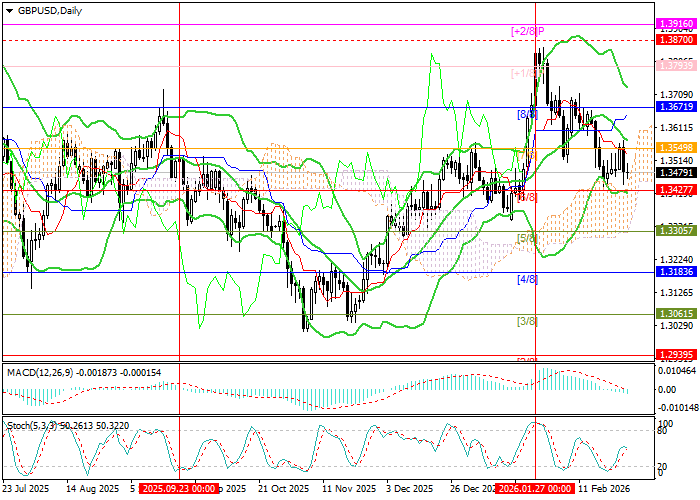
Over the past month, the pair has been in corrective mode and is now approaching the lower Bollinger Band at 1.3427 (Murray level [6/8]). A break below this level would open the way toward 1.3183 (Murray [4/8]) and 1.3061 (Murray [3/8]). Conversely, a move above 1.3671 (Murray [8/8]) could trigger a rally toward the January low at 1.3870 and 1.3916 (Murray [+2/8]).
Technical indicators remain mixed: Bollinger Bands are turning lower, the MACD histogram has slipped into negative territory, while the Stochastic oscillator is rebounding from oversold levels.
Resistance levels: 1.3671, 1.3870, 1.3916.
Support levels: 1.3427, 1.3183, 1.3061.
Trading scenarios and GBP/USD outlook
Short positions may be considered below 1.3427, with targets at 1.3183 and 1.3061 and a stop-loss at 1.3560. Time horizon: 5–7 days.
Long positions may be considered above 1.3671, targeting 1.3870 and 1.3916, with a stop-loss at 1.3580.
Scenario
| Timeframe | Weekly |
| Recommendation | SELL STOP |
| Entry point | 1.3425 |
| Take Profit | 1.3183, 1.3061 |
| Stop Loss | 1.3560 |
| Key levels | 1.3061, 1.3183, 1.3427, 1.3671, 1.3870, 1.3916 |
Alternative scenario
| Recommendation | BUY STOP |
| Entry point | 1.3675 |
| Take Profit | 1.3870, 1.3916 |
| Stop Loss | 1.3580 |
| Key levels | 1.3061, 1.3183, 1.3427, 1.3671, 1.3870, 1.3916 |