

The stock is currently under pressure due to a public dispute between Airbus, one of the world’s leading passenger aircraft manufacturers, and engine maker Pratt & Whitney, a subsidiary of RTX Corp. Airbus representatives said they were forced to cut A320neo production plans from 75 to 70 aircraft and revise their 2026 financial forecasts after Pratt & Whitney reduced engine production and deliveries for passenger jets. As a result, Airbus intends to “defend its contractual rights,” which likely implies potential litigation. If investor concerns materialize, RTX could face significant legal costs, further weighing on its shares.
Pratt & Whitney declined to comment on the situation, although company representatives previously cited production challenges due to component shortages and a large backlog of new orders. Market participants are also concerned about insider selling at RTX Corp. Last week, Executive Vice President Neil Mitchill Jr. sold 35,755 shares, reducing his holdings by 37.5%. Vice President Ramsaran Maharajh also sold 15,124 shares, cutting his stake by 53.4%.
At the same time, there is positive news for the company. On Friday, RTX management announced that the U.S. Navy approved the use of StormBreaker precision-guided missiles on F/A-18E/F Super Hornet fighter jets. The weapon system is developed by Raytheon, an RTX subsidiary. In addition, Collins Aerospace, also part of RTX, reported the successful completion of tests of its Sidekick autonomous control software for the YFQ-42A unmanned aircraft built by General Atomics as part of a U.S. Air Force collaborative combat aircraft program. According to the company, the aircraft successfully remained in flight for four hours in autonomous mode under ground operator supervision.
Overall, these developments support the medium-term earnings growth prospects of RTX Corp., despite elevated legal risks. Long-term fundamentals also remain favorable for a resumption of share price growth, as global geopolitical tensions—particularly in Europe and the Middle East—continue to push governments toward higher defense spending and increased weapons procurement.
Support and Resistance Levels
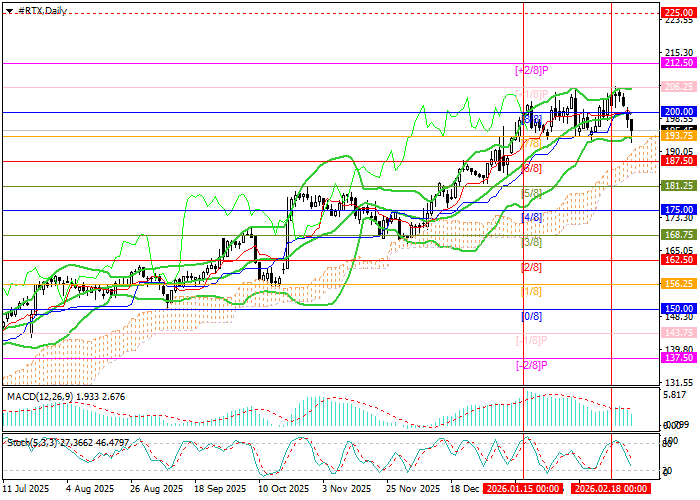
The instrument remains in an uptrend but entered a sideways range of 206.25–193.75 (Murray levels [+1/8]–[7/8]) in the middle of last month. A consolidation below the lower Bollinger Band boundary at 193.75 (Murray [7/8]) could open the way toward 175.00 (Murray [4/8]) and 168.75 (Murray [3/8]). Conversely, a breakout above the annual highs near 206.35 (Murray [+1/8]) would likely trigger a resumption of growth toward 212.50 (Murray [+2/8]) and 225.00 (Murray [+2/8], W1).
Technical indicators provide mixed signals: Bollinger Bands are trending higher, the MACD histogram is declining in positive territory, and the Stochastic oscillator is turning near oversold levels.
Resistance levels: 206.25, 212.50, 225.00.
Support levels: 193.75, 175.00, 168.75.
Trading Scenarios and RTX Corp. Price Forecast
Long positions can be opened above 206.25 with targets at 212.50 and 225.00 and a stop-loss at 201.60. Time horizon: 5–7 days.
Short positions can be opened below 193.75 with targets at 175.00 and 168.75 and a stop-loss at 200.00.