
At 09:45 (GMT+2), investors will focus on France’s consumer price index, where monthly inflation is expected to rebound from –0.2% to 0.2%, while the annual figure is projected to come in at around 0.9%. Later, at 11:00 (GMT+2), similar data from Germany will be released, with forecasts pointing to a change from –0.2% to 0.2% month-on-month and from 2.3% to 2.0% year-on-year. A move toward the lower bound of the German Bundesbank’s target range would strengthen the case for European policymakers to pause the current dovish cycle, potentially supported by today’s services PMI release at 10:55 (GMT+2). If the index continues to rise from 52.6 points, the composite indicator from 51.5 points, and the euro area figures from 52.6 and 51.9 points respectively, this could become a catalyst for further euro strength.
Meanwhile, monetary statistics point to a more resilient phase in the recovery of monetary transmission, creating a solid fundamental backdrop for sustained upside in prices. In November, annual growth of the M3 money supply accelerated to 3.0% from 2.8%, exceeding market expectations of 2.7%, signaling an expansion of system liquidity and easing constraints on financial intermediation in the banking sector. This trend is accompanied by a synchronized pickup in lending activity: household loan growth increased to 2.9% year-on-year, reaching its highest level since March 2023, while lending to non-financial corporations rose to 3.1%, the highest since June of the same year. Overall, private-sector credit growth advanced from 3.0% to 3.4%, confirming the effectiveness of current financial conditions and supporting the euro through expectations of more stable economic activity, while at the same time increasing the currency’s sensitivity to future signals from the European Central Bank (ECB).
As for the key factor shaping the current direction of EUR/USD—the US dollar—its performance remains unstable. Today, the US Dollar Index (USDX) is trading near 97.9 points, continuing a local downward trend that began after the release of US Institute for Supply Management (ISM) data. In particular, manufacturing PMI slowed sharply in December from 48.2 to 47.9 points, below both the previous month’s level and preliminary estimates of 48.3, marking the weakest reading since September 2024. Against this backdrop, the likelihood of continued dovish rhetoric from the Federal Reserve appears limited, a view also reflected in the CME FedWatch Tool, which assigns an 83.9% probability that borrowing costs will remain in the 3.50–3.75% range at the January 29 meeting.
Support and resistance levels
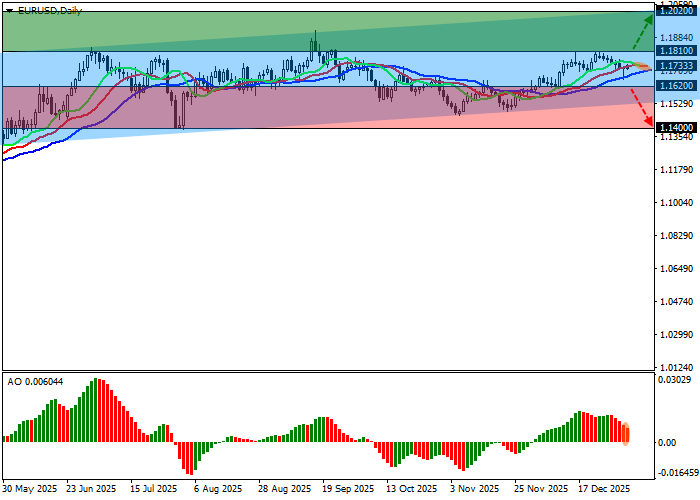
On the daily chart, the pair is attempting to approach the resistance line of the ascending channel with boundaries at 1.2000–1.1580.
Technical indicators have already turned higher and maintain a steady buy signal, although it has slightly weakened amid the correction. Fast EMAs on the Alligator indicator remain above the signal line and continue to widen the trading range, while the Awesome Oscillator histogram is forming corrective bars in the positive zone.
Support levels: 1.1620, 1.1400.
Resistance levels: 1.1810, 1.2020.
Trading scenarios and EUR/USD outlook
Long positions can be considered after a sustained breakout above 1.1810, with a target at 1.2020 and a stop-loss at 1.1750. Time horizon: 7 days or more.
Short positions can be considered after a sustained move below 1.1620, with a target at 1.1400 and a stop-loss at 1.1710.
Scenario
| Timeframe | Weekly |
| Recommendation | BUY STOP |
| Entry point | 1.1810 |
| Take Profit | 1.2020 |
| Stop Loss | 1.1750 |
| Key levels | 1.1400, 1.1620, 1.1810, 1.2020 |
Alternative scenario
| Recommendation | SELL STOP |
| Entry point | 1.1620 |
| Take Profit | 1.1400 |
| Stop Loss | 1.1710 |
| Key levels | 1.1400, 1.1620, 1.1810, 1.2020 |