

The focus of investors and forex traders is on the February report from research firm Rightmove Group Ltd.: the average house price declined by just £12 to £368,019, mainly due to adjustments in tax legislation and a 4.7% increase in average household income. At the same time, the number of residential properties listed for sale reached an 11-year high, as lenders continue to offer flexible borrowing conditions. Average mortgage rates remain at their lowest level since November 2022, with the average two-year rate currently at 4.28%, well below 4.96% a year earlier.
More than a decade after the Brexit referendum, UK and EU leaders are showing readiness to rebuild closer political and economic ties aimed at jointly addressing modern challenges related to security and competitiveness. Last year, they reaffirmed the need to deepen cooperation in defense, security, economic policy coordination, and strengthening the legal framework for bilateral initiatives. These signals come amid efforts to overcome the prolonged period of tension that followed 2016 and reflect a gradual shift toward a pragmatic approach, including recent bilateral agreements on Gibraltar and the participation of UK universities in academic exchange programs. The latter initiative предусматривает partial integration into Erasmus+, with a limited number of grants and higher costs for participants compared with the pre-Brexit period. Nevertheless, trade relations remain a key area of disagreement: according to recent estimates, UK agricultural exports to EU markets are around 40.0% below pre-2016 levels, highlighting persistent barriers and costs following changes to trade regimes. The first UK–EU joint summit since Brexit took place in May 2025 with a strong focus on collective security amid rising geopolitical tensions, and further steps are now aimed at developing coordinated strategies that take into account regional and global stability risks. At the Munich Security Conference, leaders including European Parliament President Roberta Metsola and European Commission President Ursula von der Leyen called for a “reset” of UK–EU relations based on three priorities: strengthening collective security and defense efforts, enhancing economic coordination, and protecting democratic values in an increasingly unstable global environment. This position was supported by NATO Secretary General Mark Rutte, who noted that the alliance is gradually shifting toward greater European leadership while maintaining a significant role for the United States, reflecting the current balance of investment and participation in defense.
As for the U.S. dollar, it is trading near 96.9 points on the USDX during the morning session, continuing to draw support from Friday’s inflation data. The U.S. Consumer Price Index slowed from 2.7% to 2.4% year-on-year—the lowest level since May last year—and from 0.3% to 0.2% month-on-month, compared with consensus forecasts of 2.5% and 0.3%, respectively. Core inflation, which excludes food and energy prices, eased from 2.6% to 2.5% year-on-year and rose from 0.2% to 0.3% month-on-month, reinforcing arguments for a reduction in borrowing costs by the Federal Reserve in the second half of the year, alongside labor market data. Recall that the unemployment rate fell to 4.3% versus expectations of 4.4%, while employment surged by 130.0K, exceeding both preliminary estimates of 66.0K and December’s reading of 48.0K, and average hourly earnings rose from 0.1% to 0.4% against forecasts of 0.3%. Currently, the CME FedWatch Tool indicates a 90.2% probability that the Fed will keep interest rates in the 3.50–3.75% range at its March 18 meeting.
Support and Resistance Levels
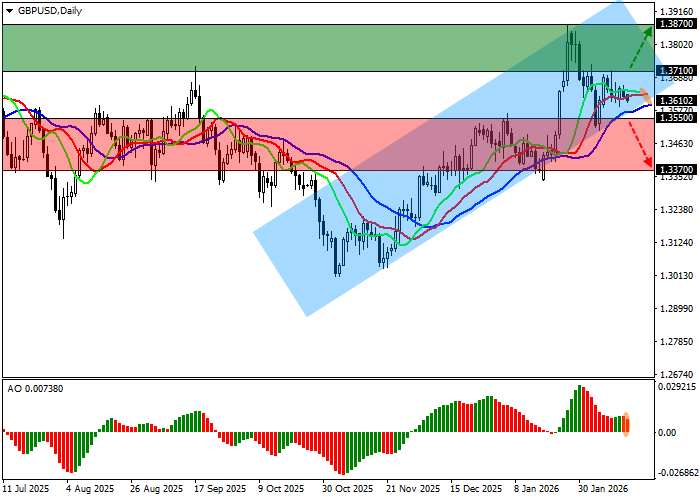
On the daily chart, the instrument is holding slightly above the support line of the ascending channel, with dynamic boundaries at 1.3900–1.3500.
Technical indicators have fully turned higher and maintain a stable buy signal that is slowing amid the correction: fast EMAs on the Alligator indicator remain above the signal line and continue to diverge from it, while the AO histogram is forming new rising bars in the buy zone.
Support levels: 1.3550, 1.3370.
Resistance levels: 1.3710, 1.3870.
Trading Scenarios and GBP/USD Forecast
Long positions may be opened after a firm breakout above 1.3710, with a target at 1.3870 and a stop-loss at 1.3640. Time horizon: 7 days or longer. Short positions may be opened after a confirmed move below 1.3550, targeting 1.3370 with a stop-loss at 1.3650.
Scenario
| Timeframe | Weekly |
| Recommendation | BUY STOP |
| Entry Point | 1.3715 |
| Take Profit | 1.3870 |
| Stop Loss | 1.3640 |
| Key Levels | 1.3370, 1.3550, 1.3710, 1.3870 |
Alternative Scenario
| Recommendation | SELL STOP |
| Entry Point | 1.3545 |
| Take Profit | 1.3370 |
| Stop Loss | 1.3650 |
| Key Levels | 1.3370, 1.3550, 1.3710, 1.3870 |