
Traffic through the Strait of Hormuz remains limited due to increased control by Iran’s Islamic Revolutionary Guard Corps (IRGC). According to Bloomberg, seven vessels departed the Persian Gulf on Saturday, including one oil tanker, two liquefied petroleum gas carriers, and four bulk carriers. All used the northern route between Larak and Qeshm islands to minimize attack risks. Tehran is also considering introducing an additional fee for "safe passage," which could increase transportation costs and put further pressure on global energy supply chains. Transit volumes remain significantly below pre-crisis levels: average flows during the first 23 days of March were about 1.6 million barrels per day. TankerTrackers.com reports that Iran-linked tankers continue to transit with transponders switched off, reducing market transparency and increasing risks for traders. A notable example includes the P.Aliki vessel carrying around 650,000 barrels of Saudi oil to Pakistan, along with two gas carriers heading toward India. Reduced shipping intensity and rising operational risks are creating a persistent geopolitical premium in oil prices and increasing volatility.
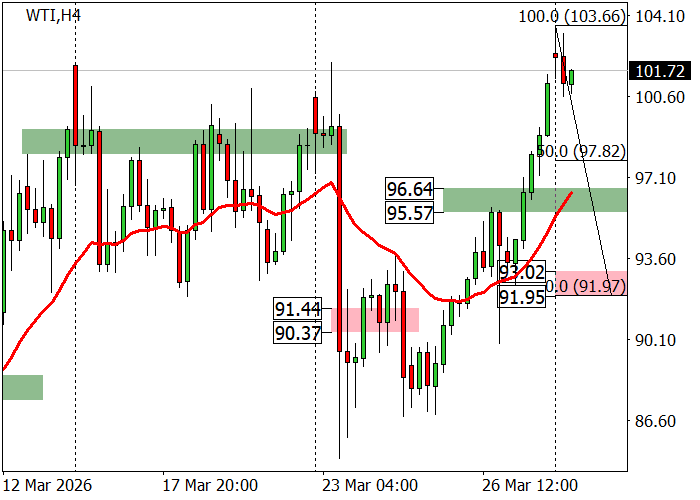
The long-term trend remains bullish, with the instrument preparing to test the February high at 101.95. If successful, the next bullish target will be 114.00, above which prices are unlikely to move in the near term. Alternatively, if sellers hold the 101.95 resistance level, a correction toward 92.37 may follow, where new long positions could be considered. A downside breakout could trigger further declines toward 86.75. Currently, prices remain above EMA 21 and EMA 190, confirming both short-term and long-term bullish trends, while RSI (14) is approaching overbought territory, limiting upside potential.
The medium-term trend turned bullish last week, with the next target zone at 107.28–106.21. A breakout above this range may open the path toward 117.92–116.85. However, if a correction develops from current levels, the key support zone at 90.91–89.84 may be tested. After testing this range, new long positions could be considered with initial targets at 95.70 and 101.55.
Support and Resistance Levels
Resistance levels: 101.95, 114.00.
Support levels: 92.37, 86.74, 81.90.
Trading Scenarios and WTI Crude Oil Forecast
Long positions may be opened from 92.37 with a target at 101.95 and a stop-loss at 89.30. Implementation period: 9–12 days.
Short positions may be opened below 89.30 with a target at 81.90 and a stop-loss at 92.37.
Scenario
| Timeframe | Weekly |
| Recommendation | BUY LIMIT |
| Entry Point | 92.37 |
| Take Profit | 101.95 |
| Stop Loss | 89.30 |
| Key Levels | 81.90, 86.74, 92.37, 101.95, 114.00 |
Alternative Scenario
| Recommendation | SELL STOP |
| Entry Point | 89.25 |
| Take Profit | 81.90 |
| Stop Loss | 92.37 |
| Key Levels | 81.90, 86.74, 92.37, 101.95, 114.00 |
Conclusion:
Oil prices remain supported by geopolitical risks and supply disruptions in key shipping routes. The bullish trend may continue if prices break above February highs. However, increased volatility remains likely as traders assess geopolitical developments and supply risks.
