
In April, the Consumer Price Index rose from 3.3% to 3.8% year-on-year, reaching its highest level since May 2023, while slowing from 0.9% to 0.6% month-on-month, in line with forecasts. Amid the blockage of the Strait of Hormuz, energy prices increased by 17.9% and 40.0%, while the core indicator, excluding food and fuel, accelerated to 2.8% and 0.4%, respectively. The gasoline price index added 5.4% over the month. These figures significantly strengthened hawkish expectations regarding US Federal Reserve policy, supporting the dollar. In addition, for the first time since April 2023, inflation in the country outpaced wage growth, while mortgage rates reached an almost 20-year high.
In the United Kingdom, on Thursday at 08:00 (GMT+2), experts will receive the gross domestic product (GDP) report for the first quarter. According to preliminary estimates, the figure may slow from 0.5% to –0.2% month-on-month and from 1.0% to 0.8% year-on-year, while accelerating from 0.1% to 0.6% quarter-on-quarter. This may increase stagflation expectations, especially given the acceleration of the Consumer Price Index to 3.3% year-on-year. In the most favorable scenario, assuming a rapid settlement of the conflict in the Middle East, the latest economic forecast from the National Institute of Economic and Social Research (NIESR) suggests that GDP growth will decline to 0.9% in 2026 and 1.0% in 2027, which is 0.5 percentage points and 0.3 percentage points lower than the February projections, while the economy would narrowly avoid recession.
On April 29, the Bank of England kept the interest rate unchanged at 3.75% in an 8–1 vote, with only Chief Economist Huw Pill voting for an increase to 4.00%, stating that the decision represented an active hold rather than a passive pause. Governor Andrew Bailey warned that second-round effects should not be expected, but markets are already fully pricing in at least two borrowing-cost increases this year. On Wednesday at 16:00 (GMT+2) and 19:00 (GMT+2), Monetary Policy Committee members Catherine Mann and Megan Greene are scheduled to speak, and their comments may clarify the regulator’s next steps. An additional factor weighing on the currency remains domestic political uncertainty: after the Labour Party’s defeat in local elections, more than 80 members of parliament called on Prime Minister Keir Starmer to resign. The day before, Deputy Housing Minister Miatta Fahnbulleh stepped down, saying that the head of government should follow her example. Nevertheless, Starmer does not intend to do so, noting that he will continue to perform his duties and hinting that he is ready for a party leadership challenge procedure.
Support and resistance levels
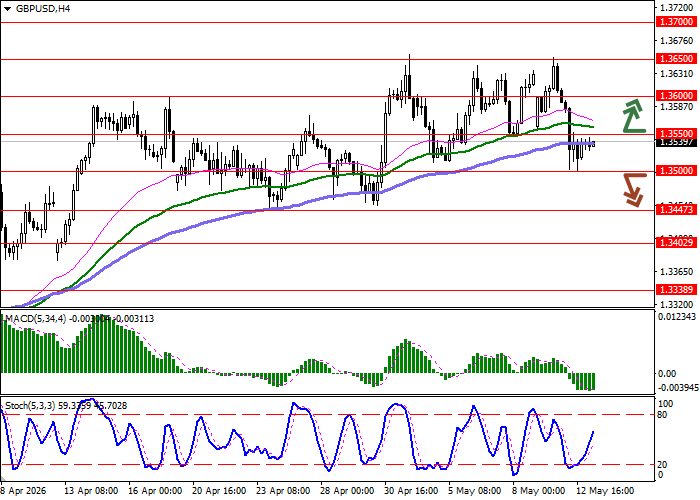
On the daily chart, Bollinger Bands are moving horizontally, while the price range is narrowing, reflecting mixed trading dynamics in the ultra-short term. The MACD indicator maintains a strong sell signal, with the histogram located below the signal line, while the Stochastic oscillator is turning downward in the middle of its working area.
Resistance levels: 1.3550, 1.3600, 1.3650, 1.3700.
Support levels: 1.3500, 1.3447, 1.3402, 1.3338.
Trading scenarios and GBP/USD forecast
Short positions may be opened after a downward breakout of 1.3500, with the target at 1.3402. Stop-loss — 1.3550. Estimated implementation period: 2–3 days.
Long positions may be opened after an upward breakout of 1.3550, with the target at 1.3650. Stop-loss — 1.3500.
Scenario
| Timeframe | Intraday |
| Recommendation | SELL STOP |
| Entry point | 1.3495 |
| Take Profit | 1.3402 |
| Stop Loss | 1.3550 |
| Key levels | 1.3338, 1.3402, 1.3447, 1.3500, 1.3550, 1.3600, 1.3650, 1.3700 |
Alternative scenario
| Recommendation | BUY STOP |
| Entry point | 1.3555 |
| Take Profit | 1.3650 |
| Stop Loss | 1.3500 |
| Key levels | 1.3338, 1.3402, 1.3447, 1.3500, 1.3550, 1.3600, 1.3650, 1.3700 |
