
Bilateral consultations were held over the weekend in Islamabad, but ended without results due to disagreements over the future operation of the Strait of Hormuz and the дальнейшее implementation of the nuclear program. The Iranian side stated that the dialogue was conducted in an atmosphere of distrust, and the authorities of the Islamic Republic generally did not expect a deal to be reached. Against this background, the Israel Defense Forces launched new strikes on Lebanese territory, while official Tehran confirmed that the negotiation track has been suspended until the attacks stop. In addition, yesterday at 17:00 (GMT+2), US armed forces began a blockade of the Strait of Hormuz, which will undoubtedly worsen the global economic situation, since official Tehran may block the Bab el-Mandeb Strait, which would have an extremely negative impact on logistics chains and energy delivery costs, while the detention of third-country vessels leaving Iranian waters could become a catalyst for further deterioration in relations between the US and China, which actively trades with Iran, thereby reviving the tariff conflict between the world’s two leading economies.
Macroeconomic data on eurozone business activity indices for March confirmed that the destabilization in the Middle East has already had a highly negative effect on the region’s economic recovery: the composite index fell to 50.7 points, the lowest level in nine months, while the services sector reading is balancing on the edge of contraction at 50.2 points. Analysts at HCOB, which conducted the survey, noted that the encouraging signs of growth seen at the beginning of the year were completely offset by the sharp rise in energy prices, changes in supply chains, and weakening consumer demand, against which new orders fell for the first time since July last year. An additional alarming signal was the rapid acceleration of inflation to a 34-month high, which led to the strongest overall increase in goods and services prices in the region since February 2024: business confidence is declining sharply, leading to job cuts.
Meanwhile, EU spending on energy imports increased by EUR 22.0 billion in just 44 days of the Middle East crisis, while the total volume of imports remained unchanged, indicating a significant increase in supply costs amid geopolitical tensions and instability in the Persian Gulf region. The key factor putting pressure on the energy market has, of course, been the blockade of the Strait of Hormuz. According to European Commission President Ursula von der Leyen, even if hostilities end quickly, disruptions in energy transportation will continue for some time. This has already led to the preparation of a package of anti-crisis measures, including stronger coordination among member states on gas purchases and storage replenishment, as well as mechanisms for the rapid use of strategic oil reserves to prevent imbalances in the single market caused by uncoordinated actions by individual countries. These proposals are expected to be presented to EU leaders at the upcoming informal meeting of the European Council in Cyprus next week.
Support and resistance levels
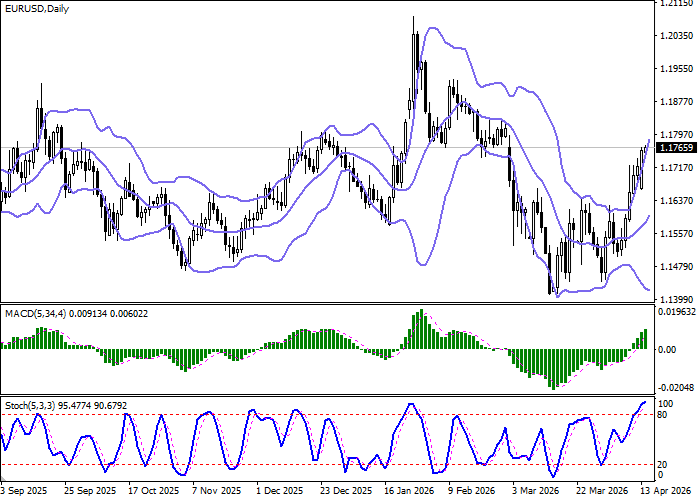
On the daily chart, Bollinger Bands continue to show confident growth: the price range is expanding upward, clearing the way for bulls toward new local highs. MACD is rising, maintaining a firm buy signal and remaining above the signal line. Stochastic is showing similar dynamics, although it is currently located very close to its maximum values, pointing to overbought risks for the euro in the ultra-short term.
Resistance levels: 1.1764, 1.1800, 1.1850, 1.1900.
Support levels: 1.1738, 1.1700, 1.1681, 1.1655.
Trading scenarios and EUR/USD forecast
Long positions may be considered after a confident breakout above 1.1800, with a target at 1.1900. Stop-loss: 1.1738. Timeframe: 2–3 days.
A return of bearish momentum followed by a breakout below 1.1700 may become a signal to open new short positions with a target at 1.1626. Stop-loss: 1.1738.
Scenario
| Timeframe | Intraday |
| Recommendation | BUY STOP |
| Entry Point | 1.1800 |
| Take Profit | 1.1900 |
| Stop Loss | 1.1738 |
| Key Levels | 1.1655, 1.1681, 1.1700, 1.1738, 1.1764, 1.1800, 1.1850, 1.1900 |
Alternative Scenario
| Recommendation | SELL STOP |
| Entry Point | 1.1700 |
| Take Profit | 1.1626 |
| Stop Loss | 1.1738 |
| Key Levels | 1.1655, 1.1681, 1.1700, 1.1738, 1.1764, 1.1800, 1.1850, 1.1900 |
