

ECB Chief Economist Philip Lane believes that inflation in the euro area may remain above the 2.0% target for a longer period, making the achievement of lasting price stability the key priority. His comments followed positive reports that the acute phase of the Middle East conflict had ended, after it had triggered a sharp rise in energy prices. However, the official stressed that the geopolitical situation remains unstable and the risk of renewed escalation persists. Following its June meeting, the ECB raised all three key interest rates by 25 basis points, including the deposit facility rate to 2.25%, and revised its inflation forecast for this year to 3.0% from the previously expected 2.6%. Governing Council member and Slovak central bank governor Peter Kažimír did not rule out further monetary tightening if necessary, noting that future decisions will depend on incoming macroeconomic data and that the fight against inflation is not over. Meanwhile, Bank of Spain Governor José Luis Escrivá pointed to stronger second-round effects: in his view, higher energy prices, particularly oil, are already spreading through other sectors of the economy, increasing costs across the production chain, raising transport and food prices, and creating additional risks for consumer inflation. Eurozone consumers’ short-term inflation expectations fell in May, while longer-term expectations remained unchanged, suggesting there is no urgent need for another rate hike yet. Expectations for the next 12 months declined to 3.5% in May from 4.0% in April, while three- and five-year expectations were unchanged at 2.9% and 2.4%, respectively. Although conditions have stabilised somewhat, the indicator remains above the level seen before the US-Iran confrontation, according to an ECB survey of 19,000 respondents across 11 eurozone countries. Consumers also became less pessimistic about the outlook, revising their forecast for economic contraction over the next year to 1.7% from 2.2% a month earlier.
US investors focused on May data for the personal consumption expenditures price indices, the Federal Reserve’s preferred inflation gauge, which broadly matched analysts’ preliminary estimates. The headline annual figure accelerated from 3.8% to 4.1%, reaching its highest level since April 2023, while the core measure rose from 3.3% to 3.4%, its highest level since October 2023. On a monthly basis, the headline reading increased by 0.4%, which was 0.1 percentage points below forecasts. This small downside surprise allowed the dollar to correct slightly and the euro to move away from intraday lows. Nevertheless, analysts note that inflationary pressure remains persistent even with the softer monthly figure, while the core measure continues to rise steadily, signalling broader price pressures beyond the energy sector. Immediately after the data release, the CME FedWatch Tool showed that the probability of policy tightening at the July meeting fell to 30.0%, while the probability for September declined to 62.0%.
Support and resistance levels
The pair has been declining actively since the middle of last month. Last week, the price tested 1.1352 (Murray level [5/8]); a consolidation below this level would open the way for a decline toward 1.1230 (Murray level [4/8]) and 1.1108 (Murray level [3/8]). Conversely, a breakout above 1.1596 (Murray level [7/8]), located above the middle line of the Bollinger Bands, could signal a reversal of the current trend and open the way toward 1.1840 (Murray level [+1/8]) and 1.1962 (Murray level [+2/8]).
Technical indicators point to the continuation of the downward trend: Bollinger Bands are directed lower, the MACD histogram is expanding in negative territory, and the Stochastic is leaving the oversold zone, not ruling out a correction, although its potential remains limited for now.
Resistance levels: 1.1596, 1.1840, 1.1962.
Support levels: 1.1352, 1.1230, 1.1108.
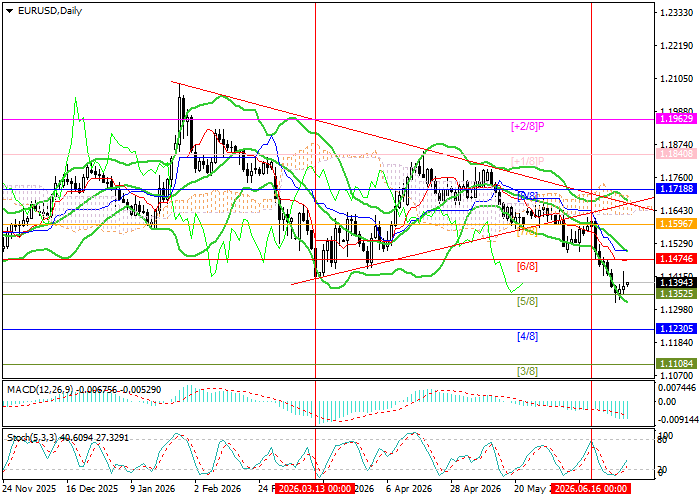
Trading Scenarios and EUR/USD Forecast
Short positions may be opened below 1.1352, with targets at 1.1230 and 1.1108, and a stop-loss at 1.1440. Timeframe: 5–7 days.
Long positions may be opened above 1.1596, with targets at 1.1840 and 1.1962, and a stop-loss at 1.1520.
Scenario
| Timeframe | Weekly |
| Recommendation | SELL STOP |
| Entry point | 1.1350 |
| Take Profit | 1.1230, 1.1108 |
| Stop Loss | 1.1440 |
| Key levels | 1.1108, 1.1230, 1.1352, 1.1596, 1.1840, 1.1962 |
Alternative Scenario
| Recommendation | BUY STOP |
| Entry point | 1.1600 |
| Take Profit | 1.1840, 1.1962 |
| Stop Loss | 1.1520 |
| Key levels | 1.1108, 1.1230, 1.1352, 1.1596, 1.1840, 1.1962 |
