

In May, the US Personal Consumption Expenditures Price Index, the Federal Reserve’s key inflation gauge, met expectations, accelerating from 3.8% to 4.1% year-on-year — the highest level since April 2023 — and to 0.4% month-on-month, 0.1 percentage points below estimates. At the same time, the core indicator, which excludes food and energy prices, rose from 3.3% to 3.4%, reaching its highest level since October 2023. The slight easing in the monthly figure triggered a modest correction in the US dollar. Following the release, according to the CME FedWatch Tool, the probability of an interest rate hike at the regulator’s July meeting fell from 34.2% to 30.0%, while the probability of a hike in September declined from 65.7% to 62.0%. Nevertheless, traders still price in at least one increase in borrowing costs before the end of the year, while Fed Chair Kevin Warsh made it clear that officials remain focused on bringing inflation back to the 2.0% target. First-quarter Gross Domestic Product (GDP) was revised upward from the previously reported 1.6% to 2.1% year-on-year, reflecting the resilience of the economy, while initial jobless claims for the week declined by 12.0 thousand to 215.0 thousand, outperforming analysts’ expectations and confirming labour market stability.
Meanwhile, Germany’s July GfK consumer confidence index is recovering more slowly than expected, and most experts forecast further deterioration. It should be recalled that at its June 11 meeting, the European Central Bank (ECB) cut the deposit rate by 25 basis points to 2.25%. However, ECB President Christine Lagarde made a dovish statement, noting that policymakers should not react aggressively to the consequences of the Middle East conflict. She also added that amid increasing geopolitical uncertainty, the EU must steadily strengthen its financial sovereignty and improve the resilience of its economic architecture. Against the backdrop of shifts in US foreign and economic policy, discussions have intensified about the need to expand the euro’s international role. According to Lagarde, the currency has significant potential to increase its influence, although becoming a fully fledged global reserve asset will require time and structural reforms. One of her key priorities is completing the Capital Markets Union, which should provide deeper integration of the bloc’s financial structures, improve capital allocation efficiency, and strengthen the region’s investment appeal. Particular attention is being paid to strengthening the autonomy of the financial system and developing domestic technological solutions in this area. According to ECB data, more than 60.0% of bank card transactions in the eurozone are processed through US payment systems, which is seen as a source of infrastructure dependence and a potential risk amid growing geopolitical instability. As one of the key solutions, Brussels is promoting the digital euro project — a central bank digital currency (CBDC) intended to complement existing cash circulation and provide citizens and businesses with an additional payment instrument. Its introduction is expected to improve transaction efficiency and accelerate the financial sector’s digital transformation, while the legal framework required to implement the project is expected to be approved before the end of the year.
Support and resistance levels
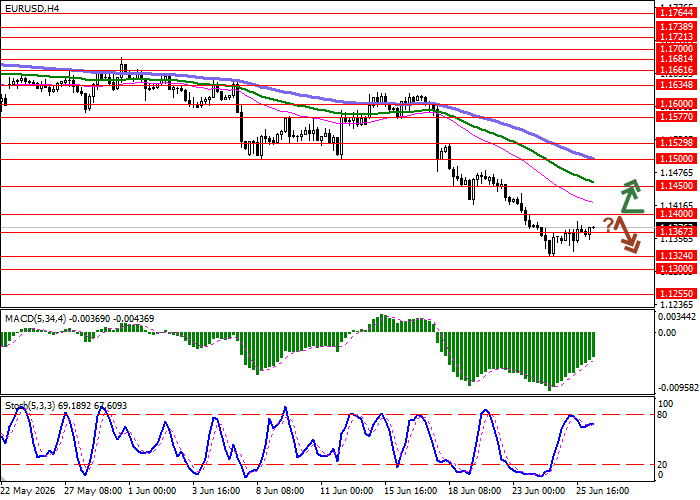
On the daily chart, the Bollinger Bands are steadily declining: the price range is expanding to the downside, leaving room for bears to reach new lows. The MACD indicator is turning upward while maintaining a sell signal, as the histogram remains below the signal line. The Stochastic, having moved away from its lows, is shifting into upward movement, reflecting the likelihood of a correction developing in the near term.
Resistance levels: 1.1400, 1.1450, 1.1500, 1.1529.
Support levels: 1.1367, 1.1324, 1.1300, 1.1255.
Trading scenarios and EUR/USD forecast
Long positions may be opened after a breakout above 1.1400, with a target at 1.1500. Stop-loss: 1.1350. Expected implementation period: 2–3 days.
Short positions may be opened after a rebound from 1.1400 and a breakdown below 1.1367, with a target at 1.1300. Stop-loss: 1.1400.
Main scenario
| Timeframe | Intraday |
| Recommendation | BUY STOP |
| Entry point | 1.1405 |
| Take Profit | 1.1500 |
| Stop Loss | 1.1350 |
| Key levels | 1.1255, 1.1300, 1.1324, 1.1367, 1.1400, 1.1450, 1.1500, 1.1529 |
Alternative scenario
| Recommendation | SELL STOP |
| Entry point | 1.1365 |
| Take Profit | 1.1300 |
| Stop Loss | 1.1400 |
| Key levels | 1.1255, 1.1300, 1.1324, 1.1367, 1.1400, 1.1450, 1.1500, 1.1529 |
