

In particular, the June US employment report will be released on Thursday at 14:30 (GMT+2), and it could significantly influence the Federal Reserve’s future monetary-policy decisions. Forecasts suggest that nonfarm payrolls may decline from 172,000 to 114,000 in June, while the unemployment rate is expected to remain at 4.3% and average hourly earnings growth at 0.3% month-on-month. For now, officials continue to take a wait-and-see approach, although their rhetoric has become more hawkish. An increasing number of Federal Open Market Committee members expect at least one rate hike by the end of the year, while the possibility of rate cuts is not currently being discussed.
Meanwhile, the Swiss National Bank (SNB) is also in no hurry to adjust borrowing conditions. In June, it left the interest rate unchanged at 0.0% for the fourth consecutive meeting, noting that this stance supports both inflation stability and the economic recovery. The regulator revised its consumer price index forecasts for 2027 and 2028 to 0.6% and 0.7%, respectively, but even with this adjustment, inflation expectations remain very subdued, especially compared with US figures. Gross domestic product (GDP) is expected to remain near 1.0% this year. The SNB reaffirmed its readiness to intervene in the foreign-exchange market if necessary to curb excessive franc appreciation, which remains an important limiting factor for further upside in the pair, although analysts assess the actual probability of intervention as low.
Meanwhile, according to Bloomberg, Switzerland has lost its status as the world’s most competitive economy, falling to third place in the 2026 IMD World Competitiveness Ranking. The decline comes amid worsening external economic conditions, including higher US trade tariffs and a stronger franc, which have pressured export-oriented industries and reduced the country’s attractiveness for capital inflows and investment. The ranking methodology includes a broad assessment of key factors such as government efficiency, infrastructure quality and development, business productivity, and macroeconomic performance. This year, Singapore and Hong Kong moved ahead of Switzerland. Additional evidence of the shifting balance of competitive advantages came from capital-flow dynamics: according to Boston Consulting Group estimates, Hong Kong also overtook Switzerland at the end of May as the leading location for cross-border capital placement.
Support and resistance levels
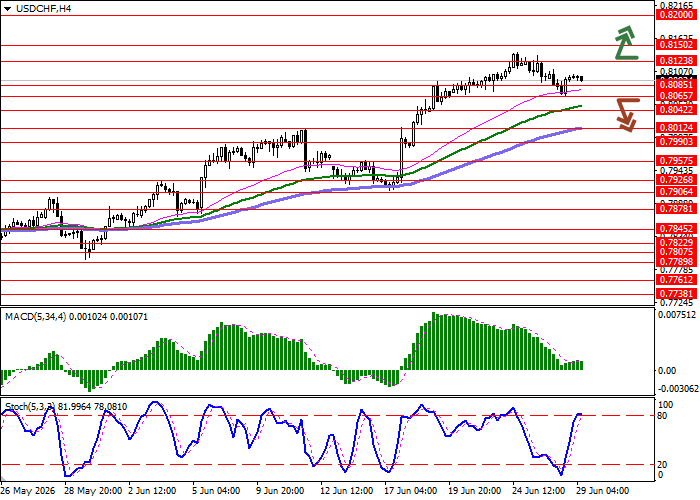
On the daily chart, Bollinger Bands are rising confidently, with the price range widening and remaining excessively broad relative to current market activity. The MACD indicator is declining while maintaining a weak sell signal, as the histogram remains below the signal line. The Stochastic is moving lower from the middle of its range, indicating sufficient room for the bearish trend to develop in the very short term.
Resistance levels: 0.8123, 0.8150, 0.8200, 0.8250.
Support levels: 0.8085, 0.8065, 0.8042, 0.8012.
Trading Scenarios and USD/CHF Forecast
Short positions may be opened after a breakdown below 0.8065, with the target at 0.8012. Stop-loss — 0.8100. Timeframe: 2–3 days. Long positions may be opened after a breakout above 0.8123, with the target at 0.8200. Stop-loss — 0.8085.
Scenario
| Timeframe | Intraday |
| Recommendation | SELL STOP |
| Entry point | 0.8060 |
| Take Profit | 0.8012 |
| Stop Loss | 0.8100 |
| Key levels | 0.8012, 0.8042, 0.8065, 0.8085, 0.8123, 0.8150, 0.8200, 0.8250 |
Alternative Scenario
| Recommendation | BUY STOP |
| Entry point | 0.8125 |
| Take Profit | 0.8200 |
| Stop Loss | 0.8085 |
| Key levels | 0.8012, 0.8042, 0.8065, 0.8085, 0.8123, 0.8150, 0.8200, 0.8250 |
