
The main driver behind the US dollar’s strength remains the US Federal Reserve’s hawkish shift at its June 17 meeting — the first chaired by new Fed Chair Kevin Warsh — when officials unanimously kept the interest rate within the 3.50–3.75% range. According to the regulator, the labour market remains stable, with employment growth matching labour-force expansion and unemployment remaining largely unchanged. Investment activity also remains strong, while productivity growth is accelerating. The accompanying statement separately highlighted the impact of external factors, including the conflict in the Middle East, which is increasing uncertainty for the global economy and individual sectors.
As expected, the Bank of Japan raised its key short-term interest rate by 25 basis points to 1.00%, its highest level since 1995. However, the move provided little support for the yen, only slightly slowing bullish activity in the pair. Several officials reportedly called for faster tightening, including rate adjustments every few months, while significant disagreements remain within the regulator. A key signal was the dovish vote from Toichiro Asada, the first Bank of Japan board member appointed by Prime Minister Sanae Takaichi, reflecting growing political pressure on the monetary-policy normalisation process. Meanwhile, in June, the core consumer price index excluding fresh food accelerated from 1.3% to 1.6% year-on-year, in line with expectations. The index excluding both fresh food and energy rose from 1.6% to 1.9%, while the headline figure reached 1.7% due to higher water charges after support measures were withdrawn. Fuel costs continued to decline thanks to government subsidies.
Canada and Japan signed a series of commercial agreements worth more than USD 1.7 billion during the Team Canada trade mission. Canadian Minister of International Trade Maninder Sidhu announced the signing of fourteen separate agreements aimed at expanding and institutionalising economic cooperation between the two countries. The deals reflect the strategic nature of bilateral relations and strengthen the partners’ positions as complementary trade and investment players in the Asia-Pacific region, where both economies traditionally view each other as key access points to technology, manufacturing, and services. The Team Canada trade mission serves as a coordinated platform for Canadian businesses and government institutions to promote export and investment opportunities in foreign markets. Although the detailed structure of the agreements has not been disclosed, their combined value points to substantial cooperation.
Meanwhile, the possibility of currency intervention by Japanese authorities remains the key factor preventing the pair from moving above 162.00. Traders remain on high alert for intervention, especially after the Ministry of Finance carried out record intervention at the end of April. It is worth noting, however, that previous measures are unlikely to fundamentally change the broader situation.
Support and resistance levels
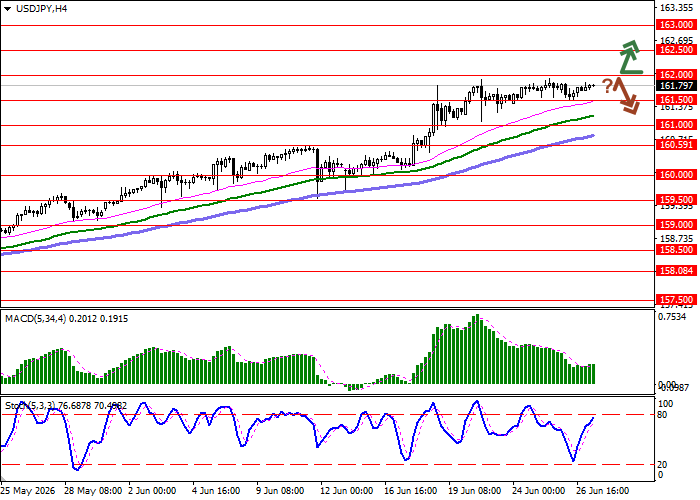
On the daily chart, Bollinger Bands are rising confidently, with the price range widening and opening the way for bulls to test new highs. The MACD indicator has turned lower, forming a weak sell signal as the histogram moves below the signal line, while the Stochastic is attempting to consolidate below the 80 level, reflecting the possibility of overbought conditions in the very short term.
Resistance levels: 162.00, 162.50, 163.00, 163.50.
Support levels: 161.50, 161.00, 160.59, 160.00.
Trading Scenarios and USD/JPY Forecast
Long positions may be opened after a breakout above 162.00, with the target at 163.00. Stop-loss — 161.50. Timeframe: 2–3 days.
Short positions may be opened after a rebound from 162.00 and a breakdown below 161.50, with the target at 160.59. Stop-loss — 162.00.
Scenario
| Timeframe | Intraday |
| Recommendation | BUY STOP |
| Entry point | 162.05 |
| Take Profit | 163.00 |
| Stop Loss | 161.50 |
| Key levels | 160.00, 160.59, 161.00, 161.50, 162.00, 162.50, 163.00, 163.50 |
Alternative Scenario
| Recommendation | SELL STOP |
| Entry point | 161.45 |
| Take Profit | 160.59 |
| Stop Loss | 162.00 |
| Key levels | 160.00, 160.59, 161.00, 161.50, 162.00, 162.50, 163.00, 163.50 |
