

On June 18, the regulator kept the interest rate unchanged at 3.75%, while two officials supported raising it to 4.00%. At the same time, the consumer price index remained at 2.8% year-on-year in May, the core measure accelerated to 2.6%, and services inflation reached 3.7%. As a result, the Bank of England is still unable to confidently shift toward monetary easing. Bullish activity remains restrained as investors are concerned about escalating domestic political uncertainty. Earlier, Prime Minister Keir Starmer announced his resignation, while newly elected MP Andy Burnham, the former Mayor of Manchester, is seen as the leading candidate to head the ruling party and could become the country’s leader after the July 17 election.
On Monday, the official is expected to outline his views on national and fiscal policy. Traders fear an increase in government bond issuance to finance higher spending, which could weigh heavily on the budget and widen the deficit. Meanwhile, gross domestic product (GDP) contracted by 0.1% in April after expanding by 0.3% in March and 0.4% in February, while the labour market is showing signs of cooling. Employment change came in at –53,000 month-on-month, while the preliminary estimate for May showed a change of –119,000 year-on-year. A positive factor was the increase in May retail sales from –1.0% to 1.2%, although this is still insufficient to fully offset weak business activity. In June, the services PMI is expected to stand at 48.7 points, below the forecast of 50.1 points and May’s 49.3 points, while the composite index is expected at 49.4 points, compared with 50.6 points and 49.7 points, respectively.
The US dollar is supported by the Federal Reserve’s more restrictive stance. At its June meeting, the regulator kept the interest rate in the 3.50–3.75% range, influenced by the May increase in the personal consumption expenditures price index of 4.1%, the core measure of 3.4%, and growth in consumer spending and personal income of 0.7% in both cases. The employment sector remains stable, with nonfarm payrolls previously increasing by 172,000 and unemployment remaining near 4.3%.
Against this backdrop, the dollar retains an advantage, limiting GBP/USD’s recovery potential above 1.3321.
Support and resistance levels
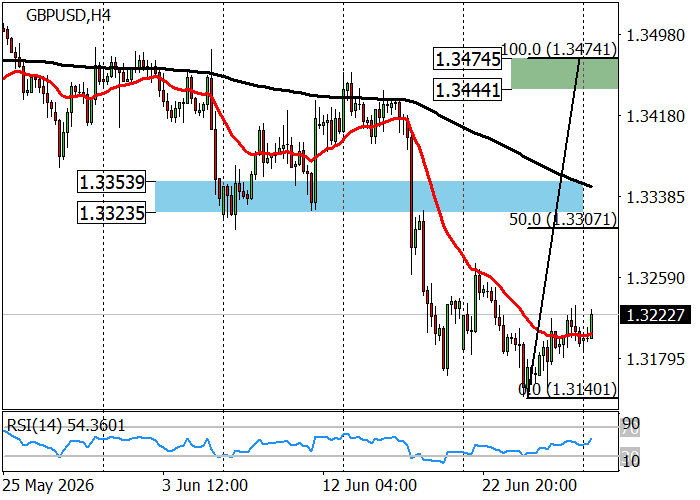
Within the long-term downtrend, the instrument approached the key support level of 1.3172 last week, formed near the March and April lows. Today, it is developing upward momentum from this level, which may extend toward the resistance level of 1.3321, where short positions with a target at 1.3172 may become relevant.
The medium-term trend turned bearish two weeks ago after the key support area of 1.3353–1.3323 was broken, following the achievement of the first upside target at 1.3490. The next targets for short positions are zone 2 at 1.3049–1.3019 and last week’s low at 1.3140. These positions may be considered from the resistance area of 1.3474–1.3441.
Resistance levels: 1.3321, 1.3508.
Support levels: 1.3172, 1.3037.
Trading Scenarios and GBP/USD Forecast
Short positions may be opened from 1.3321, with a target at 1.3172 and a stop-loss at 1.3371. Timeframe: 9–12 days. Long positions may be opened above 1.3371, with a target at 1.3508 and a stop-loss at 1.3309.
Scenario
| Timeframe | Weekly |
| Recommendation | SELL LIMIT |
| Entry point | 1.3321 |
| Take Profit | 1.3172 |
| Stop Loss | 1.3371 |
| Key levels | 1.3037, 1.3172, 1.3321, 1.3508 |
Alternative Scenario
| Recommendation | BUY STOP |
| Entry point | 1.3375 |
| Take Profit | 1.3508 |
| Stop Loss | 1.3309 |
| Key levels | 1.3037, 1.3172, 1.3321, 1.3508 |
