

Recall that the Japanese regulator raised the interest rate to 1.00%, its highest level since 1995: officials stressed that the tightening cycle will continue, while further changes will be made depending on the macroeconomic situation and inflation dynamics. According to Friday’s data, the core indicator, excluding food and energy prices, rose by 1.8% in May, slowing from 1.9% in the previous month and remaining below the 2.0% target for the fourth consecutive month. The headline figure adjusted to 1.5% from 1.4%. It should be noted that inflation has shown restrained growth this year, mainly due to government subsidies for fuel and utility services designed to offset higher energy prices caused by the conflict in the Middle East. At the same time, the Bank of Japan’s accompanying statement noted that from April next year it will complete the reduction of government bond purchases, stabilizing them at around 2.0 trillion yen per month and effectively returning to the parameters that existed before the launch of the large-scale economic stimulus program in 2013.
In addition, it became known last week that the Japanese government is developing plans to invest around 370.0 trillion yen in artificial intelligence (AI) technologies and other key strategic sectors by fiscal year 2040, which could exceed 2.0 trillion dollars in total: the project will be supported not only by public but also by private funding. The government’s Economic Growth Strategy Council identified 17 areas of central importance for Japan’s future economic security, including AI, shipbuilding, critical minerals, and next-generation quantum computing.
Meanwhile, the U.S. dollar received support after the conclusion of the two-day U.S. Federal Reserve monetary policy meeting — the first under the chairmanship of Kevin Warsh. As expected, officials unanimously supported keeping the interest rate in the 3.50–3.75% range, but investors focused primarily on the rhetoric of Board members. In particular, the accompanying statement completely removed the wording about a “soft policy bias,” which had previously implied that the next step would be a reduction in borrowing costs, while the median inflation projection for the end of the year was sharply raised to 3.6% from 2.7% in March. The Federal Open Market Committee (FOMC) also noted that maintaining current monetary policy parameters is consistent with fulfilling the financial authority’s dual mandate. The statement emphasized that the national economy continues to show stable growth despite persistent uncertainty and also expressed the intention to maintain a sufficient level of reserves in the banking system.
Tomorrow at 15:45 (GMT+2), market participants will focus on preliminary business activity data: the manufacturing indicator is likely to adjust from 55.1 points to 54.6 points, while the services indicator is expected to rise from 50.7 points to 51.0 points.
Support and resistance levels
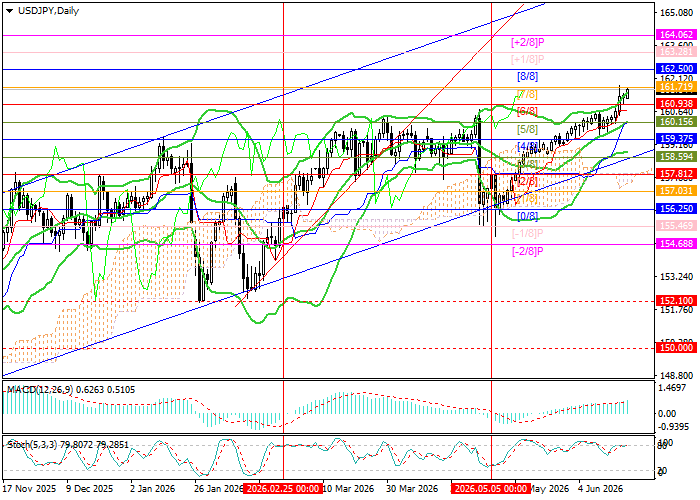
The instrument is trading within a long-term ascending channel: at the beginning of last month, quotes unsuccessfully tested its lower boundary and have been rising continuously since then. They are currently testing 161.71 (Murray level [7/8]), consolidation above which will allow the price to reach targets at 163.28 (Murray level [+1/8]) and 164.06 (Murray level [+2/8]). The key level for bears is 159.37 (Murray level [4/8]), below the middle line of the Bollinger Bands: if it is broken, the asset may leave the ascending channel and continue moving toward 157.03 (Murray level [1/8]) and 156.25 (Murray level [0/8]).
Technical indicators allow for the continuation of the current trend: Bollinger Bands are directed upward, the MACD histogram is increasing in the positive zone, and the Stochastic is moving horizontally near the overbought area.
Resistance levels: 161.71, 163.28, 164.06.
Support levels: 159.37, 157.03, 156.25.
USD/JPY trading scenarios and forecast
Long positions should be opened above 161.71 with targets at 163.28 and 164.06, and a stop-loss at 160.60. Expected timeframe: 5–7 days.
Short positions should be opened below 159.37 with targets at 157.03 and 156.25, and a stop-loss at 160.70.
Scenario
| Timeframe | Weekly |
| Recommendation | BUY STOP |
| Entry point | 161.75 |
| Take Profit | 163.28, 164.06 |
| Stop Loss | 160.60 |
| Key levels | 156.25, 157.03, 159.37, 161.71, 163.28, 164.06 |
Alternative scenario
| Recommendation | SELL STOP |
| Entry point | 159.35 |
| Take Profit | 157.03, 156.25 |
| Stop Loss | 160.70 |
| Key levels | 156.25, 157.03, 159.37, 161.71, 163.28, 164.06 |
