

Yesterday, US President Donald Trump hinted that consultations with the leadership of the Islamic Republic could resume in the near future, though no longer with Pakistan as a mediator. He also stated that the purpose of the maritime isolation is specifically to pressure the opposing side into returning to peace talks. All of these comments have been perceived positively by the market, although experts also point to the significant risks created by Washington’s recent moves. The issue is that China has substantial economic ties with Iran, and Chinese authorities have already stated that they will not comply with restrictions initiated by the United States, continuing to fulfill obligations to their trading partners. As a result, any attempt to detain Chinese vessels could provoke reciprocal measures, increasing the risks of further trade war escalation and a deeper global economic slowdown. Nevertheless, no ships have yet been stopped during the operations, which is adding to market optimism and supporting demand for risk assets.
Local support for the pound comes from the release of strong March data from the British Retail Consortium (BRC): against the backdrop of the Easter holidays and stronger shopping activity, the annual indicator rose by 3.1%, above both forecasts (0.9%) and the February reading (0.7%), although demand across non-food categories remained uneven. Consumer demand shifted toward computer equipment and home goods, while the clothing segment showed relatively weaker demand. It is also worth noting the March report from financial conglomerate Barclays, according to which consumer spending growth slowed from 1.0% to 0.9% in March due to reduced travel, but still remained fairly strong. Overall, consumer demand in the UK economy appears relatively resilient despite ongoing pressure from the fuel crisis and related costs, which partly reduces the risks of a sharp slowdown in business activity.
Thus, the current fundamental background remains favorable for the medium-term growth of GBP/USD, although any negative geopolitical signals could once again push the pair lower.
Support and resistance levels
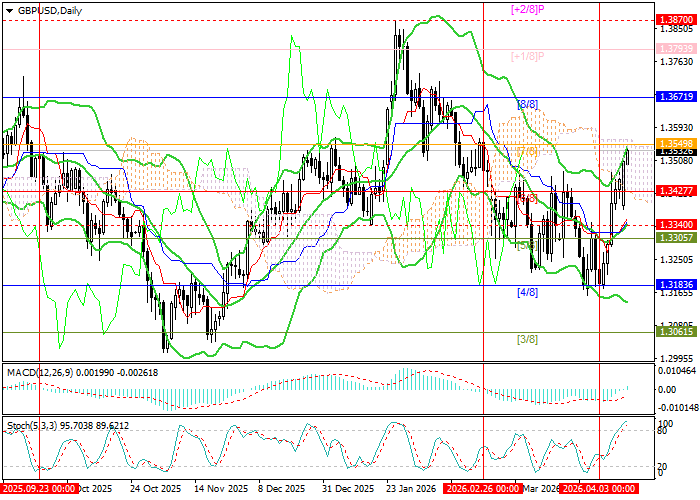
The instrument is approaching the 1.3549 level (Murray [7/8]), and consolidation above it would become a catalyst for stronger upward momentum toward the targets at 1.3671 (Murray [8/8]) and 1.3870 (the area of January highs). The key level for the bears appears to be the middle Bollinger Band near 1.3340: a breakout below it would allow sellers to gain a foothold around 1.3183 (Murray [4/8]) and 1.3061 (Murray [3/8]).
Technical indicators still allow for further growth: Bollinger Bands are turning upward, the MACD histogram has moved into positive territory, and Stochastic has entered the overbought zone, not ruling out a reversal and correction, although the potential for such a move still appears limited.
Resistance levels: 1.3549, 1.3671, 1.3870.
Support levels: 1.3340, 1.3183, 1.3061.
Trading scenarios and GBP/USD forecast
Long positions may be considered above 1.3549 with targets at 1.3671 and 1.3870, with a stop-loss at 1.3460. Implementation period: 5–7 days.
Short positions may be considered below 1.3340 with targets at 1.3183 and 1.3061, with a stop-loss at 1.3430.
Scenario
| Timeframe | Weekly |
| Recommendation | BUY STOP |
| Entry Point | 1.3550 |
| Take Profit | 1.3671, 1.3870 |
| Stop Loss | 1.3460 |
| Key Levels | 1.3061, 1.3183, 1.3340, 1.3549, 1.3671, 1.3870 |
Alternative Scenario
| Recommendation | SELL STOP |
| Entry Point | 1.3335 |
| Take Profit | 1.3183, 1.3061 |
| Stop Loss | 1.3430 |
| Key Levels | 1.3061, 1.3183, 1.3340, 1.3549, 1.3671, 1.3870 |
