

Market attention has focused on consumption data, with Japan’s household spending falling by 1.8% year-on-year in February versus a forecast of –0.8%, signaling weak domestic demand. At the same time, inflation data showed annual price growth accelerating to 2.6% from a revised 2.1% in February, while import prices rose by 7.9% year-on-year. Against this backdrop, investors and forex traders are now pricing in a 60.0% probability of a Bank of Japan rate hike at the April 27–28 meeting. Even so, these drivers have not been enough to accelerate downside pressure in USD/JPY. Inflation in Japan remains largely import-driven, particularly due to higher energy costs, while weak domestic consumption limits the central bank’s ability to pursue more aggressive monetary tightening.
Meanwhile, the Japanese government has approved an expansion of its strategic petroleum reserve program and supply diversification efforts. The plan предусматривает the release of oil volumes equivalent to 20 days of consumption starting in May, adding to earlier measures that already brought an amount equal to 50 days of demand onto the market. Japan, which depends on the Middle East for roughly 95.0% of its energy imports, is seeking to reduce its exposure to geopolitical risks by exploring alternative supply routes, including shipments from the United Arab Emirates via the Port of Fujairah and from Saudi Arabia via the Port of Yanbu.
For US investors, the key event last week was undoubtedly the March inflation report. It showed consumer prices rising from 0.3% to 0.9% month-on-month and from 2.4% to 3.3% year-on-year, compared with preliminary estimates of 1.0% and 3.4%, respectively. Meanwhile, the core indicator, which excludes food and energy prices, came in at 0.2% on a monthly basis and increased from 2.5% to 2.6% annually.
Gasoline prices surged by 21.2% over the month, accounting for nearly three-quarters of the monthly increase in inflation. At the same time, the labor market has not shown signs of sharp cooling. Weekly jobless claims rose only to 219.0K, above both forecasts of 210.0K and the previous reading of 203.0K. However, the four-week average edged up from 208.0K to 209.5K, while the total number of people receiving government assistance fell from 1.832M to 1.794M, compared with expectations of 1.840M. In addition, San Francisco Federal Reserve President Mary Daly said the US economy remains stable, while noting that the “energy shock” is negatively affecting progress toward the Fed’s 2.0% inflation target.
Support and resistance levels
The long-term trend remains bullish. Last month, the instrument tested the 159.47 resistance level but failed to consolidate above it and has now returned to this mark once again. If the pair manages to break through, the next upside target for bulls will be the July 2024 high at 161.78. Otherwise, a correction toward support at 157.32 may begin, where fresh long positions could be considered with a target at 159.47.
The medium-term trend is also bullish. Buyers are still moving toward Zone 4 at 163.22–162.64, while the nearest strong support is located in the 157.63–157.35 range. If the price reaches this area, long positions may be considered with a first target at 158.90 and a second target at 160.46. Otherwise, the correction could extend toward the trend boundary at 154.89–154.36, where buying opportunities with a target at 160.46 would again become relevant.
Resistance levels: 159.47, 161.78, 164.07.
Support levels: 157.32, 153.76, 152.55.
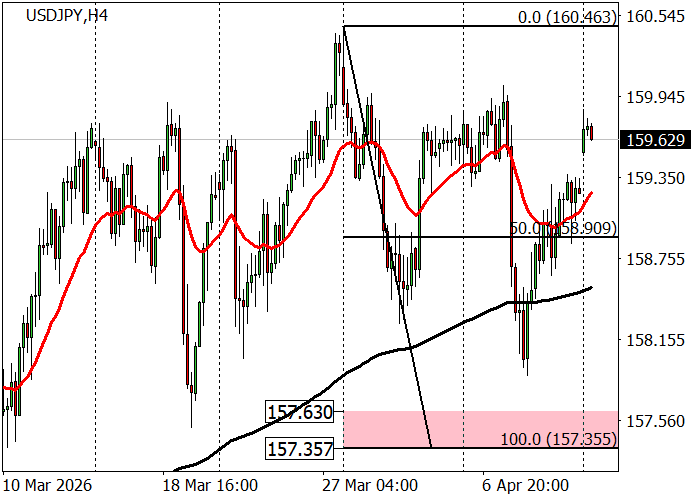
USD/JPY Trading Scenarios and Forecast
Long positions may be opened from 157.32 with a target at 159.47 and a stop-loss at 156.62. Timeframe: 9–12 days.
Short positions may be opened below 156.62 with a target at 153.76 and a stop-loss at 158.00.
Scenario
| Timeframe | Weekly |
| Recommendation | BUY LIMIT |
| Entry Point | 157.32 |
| Take Profit | 159.47 |
| Stop Loss | 156.62 |
| Key Levels | 152.55, 153.76, 157.32, 159.47, 161.78, 164.07 |
Alternative Scenario
| Recommendation | SELL STOP |
| Entry Point | 156.60 |
| Take Profit | 153.76 |
| Stop Loss | 158.00 |
| Key Levels | 152.55, 153.76, 157.32, 159.47, 161.78, 164.07 |
USD/JPY continues to trade with a bullish bias as weak domestic demand in Japan limits support for the yen despite rising inflation expectations. If the pair breaks above 159.47, momentum could extend toward 161.78, while a rejection may trigger a correction toward the 157.32 support area.
