

According to the document, all 19 participants in the Federal Open Market Committee's (FOMC) September policy discussions supported raising the federal funds target range to 3.75–4.00%, while the formal decision was approved unanimously by the 12 voting members. Officials agreed that the risks of inflation remaining persistently above the 2.0% target were still significant, as economic growth remained resilient and the labour market was close to maximum employment. Under these conditions, most policymakers consider another increase in borrowing costs before the end of the year appropriate. However, some officials believe there is no urgent need for further monetary tightening, as incoming data indicate some moderation in inflationary pressures.
In August, the Personal Consumption Expenditures (PCE) price index increased by 3.4% year-on-year compared with expectations of 3.7%, while the core indicator reached 3.0% versus forecasts of 3.3%. In September, the unemployment rate rose from 4.1% to 4.2%, while nonfarm payrolls increased by only 29.0K. Against this background, the probability of another interest rate increase by the December meeting remains high, at approximately 85%, according to market expectations reflected in the CME FedWatch Tool. This continues to provide support for the US currency.
DollarIn addition, demand for the dollar as a safe-haven asset is being stimulated by concerns over a possible resumption of large-scale military operations between the United States and Iran. According to NBC News, President Donald Trump and members of his administration have discussed options for renewed US strikes against Iran, potentially before the congressional midterm elections. Reported military options include attacks on strategic infrastructure, although no final decision has been announced. Any further escalation could lead to higher energy prices and an additional acceleration in inflation.
The pair's upward movement is being limited by the Bank of Japan's latest report from its quarterly meeting of regional branch managers, which highlighted concerns that higher fuel prices are increasingly being passed on to consumer goods. At the same time, Japan's economy remains relatively stable, supported by strong demand for electronic products, machinery and telecommunications infrastructure associated with the development of artificial intelligence (AI) technologies. These conditions could support another interest rate increase by the Bank of Japan later this year, providing some support for the yen.
As discussed in our previous USD/JPY forecast, expectations of further Bank of Japan monetary tightening remain an important factor limiting the pair's upside potential.
Overall, the probability of further USD/JPY strengthening remains elevated.
Support and resistance levels
The trading instrument reversed near the lower boundary of the medium-term descending channel and consolidated above 157.81 (Murray level [5/8]). After overcoming 159.37 (Murray level [6/8]), the price may break out of the range and continue rising toward 162.50 (Murray level [8/8]), 164.06 (Murray level [+1/8]) and 165.62 (Murray level [+2/8]). However, if the pair consolidates below the middle Bollinger Band at 156.25 (Murray level [4/8]), a decline toward 153.12 (Murray level [2/8]) and 151.56 (Murray level [1/8]) may follow.
Technical indicators maintain a buy signal: the Bollinger Bands and Stochastic oscillator are turning upward, while the MACD histogram remains close to the zero line with limited volumes.
Resistance levels: 159.37, 162.50, 164.06, 165.62.
Support levels: 156.25, 153.12, 151.56.
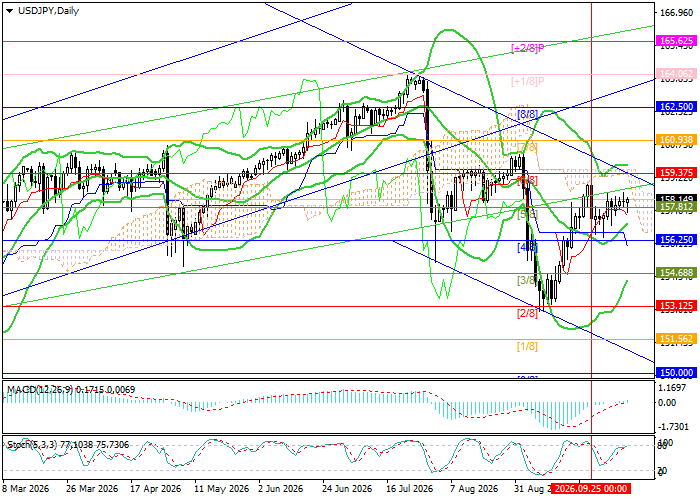
USD/JPY trading scenarios and exchange rate forecast
Long positions may be opened above 159.37 with targets at 162.50, 164.06 and 165.62 and a stop-loss at 157.20. Estimated implementation period: 5–7 days.
Short positions may be opened below 156.25 with targets at 153.12 and 151.56 and a stop-loss at 158.60.
Scenario
| Timeframe | Weekly |
| Recommendation | BUY STOP |
| Entry point | 159.37 |
| Take Profit | 162.50, 164.06, 165.62 |
| Stop Loss | 157.20 |
| Key levels | 151.56, 153.12, 156.25, 159.37, 162.50, 164.06, 165.62 |
Alternative scenario
| Recommendation | SELL STOP |
| Entry point | 156.25 |
| Take Profit | 153.12, 151.56 |
| Stop Loss | 158.60 |
| Key levels | 151.56, 153.12, 156.25, 159.37, 162.50, 164.06, 165.62 |
