
The regulator continues to maintain its policy rate at 0.0%, as the price shocks caused by the energy crisis and escalating geopolitical tensions in the Persian Gulf have affected Switzerland less severely than many other economies. According to the latest data, the Consumer Price Index increased from 0.8% to 1.0% year-on-year in September, reaching its highest level in approximately two years while remaining within the SNB's 0.0–2.0% price stability range. The increase was mainly driven by higher fuel and energy costs, while broader consumer price pressures remained relatively subdued. Officials believe that much of the current inflationary pressure is temporary, reducing the need for monetary policy adjustments in the medium term.
As discussed in our previous USD/CHF forecast, Switzerland's relatively low inflation and the significant interest rate differential between the United States and Switzerland remain important factors supporting the pair.
In contrast, the minutes from the Federal Reserve's September meeting confirm that US policymakers continue to maintain a hawkish stance. According to the document, most participants in the Federal Open Market Committee (FOMC) believe another interest rate increase before the end of the year will likely be appropriate to ensure a sustainable decline in inflation toward the 2.0% target.
Although the regulator has not provided a precise timetable for further tightening, analysts expect borrowing costs to increase in December. In August, the Personal Consumption Expenditures (PCE) price index rose by 3.4% year-on-year compared with expectations of 3.7%, while the core indicator reached 3.0% instead of the expected 3.3%. At the same time, signs of cooling appeared in the US labour market, with unemployment increasing to 4.2% in September and nonfarm payrolls rising by only 29.0K.
Against this background, market expectations continue to favour a pause in October, followed by a possible rate increase in December. According to the CME FedWatch Tool, the probability of another increase by the end of the year remains close to 85.0%. Federal Reserve Governor Christopher Waller also stated that additional rate hikes would likely be needed to bring inflation back to target, although policymakers have flexibility regarding the timing and pace of further monetary tightening.
Overall, monetary policy differences between the Federal Reserve and the Swiss National Bank continue to support the possibility of further USD/CHF strengthening.
Support and resistance levels
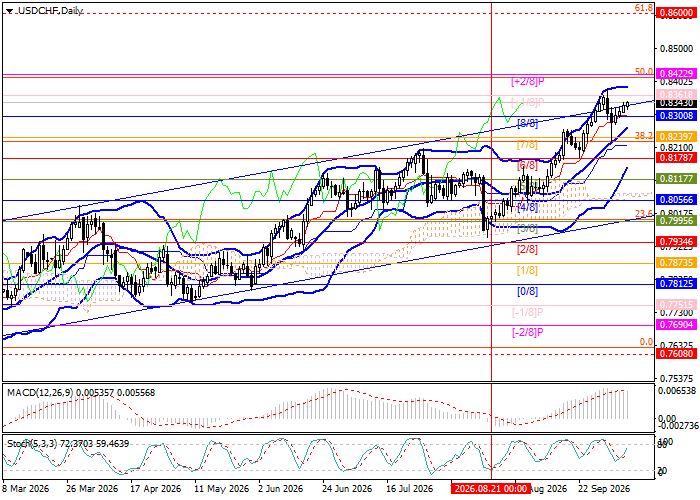
The trading instrument is approaching the upper boundary of the ascending channel near 0.8361 (Murray level [+1/8]). A breakout above this level may allow the pair to reach 0.8600 (61.8% Fibonacci retracement). However, if the price breaks below the middle Bollinger Band at 0.8239 (Murray level [7/8], 38.2% Fibonacci retracement), a correction toward 0.8056 (Murray level [4/8]) and 0.7995 (Murray level [3/8], 23.6% Fibonacci retracement) may develop.
Technical indicators maintain a buy signal: the Bollinger Bands and Stochastic oscillator are turning upward, while the MACD histogram remains stable in positive territory.
Resistance levels: 0.8361, 0.8600.
Support levels: 0.8239, 0.8056, 0.7995.
USD/CHF trading scenarios and exchange rate forecast
Long positions may be opened above 0.8361 with a target at 0.8600 and a stop-loss at 0.8260. Estimated implementation period: 5–7 days.
Short positions may be opened below 0.8239 with targets at 0.8056 and 0.7995 and a stop-loss at 0.8330.
Scenario
| Timeframe | Weekly |
| Recommendation | BUY STOP |
| Entry point | 0.8361 |
| Take Profit | 0.8600 |
| Stop Loss | 0.8260 |
| Key levels | 0.7995, 0.8056, 0.8239, 0.8361, 0.8600 |
Alternative scenario
| Recommendation | SELL STOP |
| Entry point | 0.8239 |
| Take Profit | 0.8056, 0.7995 |
| Stop Loss | 0.8330 |
| Key levels | 0.7995, 0.8056, 0.8239, 0.8361, 0.8600 |
