

Trading activity remains elevated, while prices are being supported by persistent geopolitical tensions in the Persian Gulf and Red Sea regions. The immediate risks to energy supplies now come not only from disruptions around the Strait of Hormuz but also from renewed fighting in Yemen and attacks on Saudi energy and transport infrastructure.
Saudi-backed Yemeni government forces have launched a large-scale offensive against Houthi positions near the Bab el-Mandeb Strait, while the Houthis have responded with missile and drone attacks against targets in Saudi Arabia. The group claimed attacks on King Khalid International Airport in Riyadh, Saudi Aramco facilities and several military targets.
Maritime security risks also remain elevated. At least seven attacks on tankers were reported during the first days of October, while UK Maritime Trade Operations (UKMTO) separately reported that a crude oil tanker was struck by an unidentified projectile off Oman. No casualties or significant environmental damage were reported in that incident.
At the same time, physical oil supplies from the Middle East have recovered substantially. Gulf crude and fuel flows excluding Iran averaged around 19.2 million barrels per day in September, approximately 81% of pre-war levels, while crude and condensate exports recovered to around 91%. This improvement is limiting the upside in Brent despite continuing geopolitical risks.
The latest weekly report from the American Petroleum Institute (API) will be released today at 22:30 (GMT+2). The previous report showed an increase in US crude inventories of 1.019 million barrels. Similar data from the US Energy Information Administration (EIA) will be published tomorrow at 16:30 (GMT+2), after the previous release showed a build of 0.922 million barrels. A clear market consensus for the upcoming releases has not yet been established.
Oil-market activity remains high as traders balance recovering Middle Eastern exports against persistent risks to shipping, energy infrastructure and refined-product supplies.
As discussed in our previous Brent Crude Oil forecast, geopolitical developments around the Persian Gulf and Red Sea remain the main drivers of short-term price volatility.
Support and resistance levels
On the daily chart, the trading instrument is moving higher while remaining below the resistance line of the global ascending channel with dynamic boundaries of 112.00–95.00.
Technical indicators are strengthening the buy signal: the fast EMAs of the Alligator indicator remain above the signal line and continue to move away from it, while the AO histogram is forming corrective bars in positive territory.
Support levels: 97.30, 89.60.
Resistance levels: 102.00, 109.00.
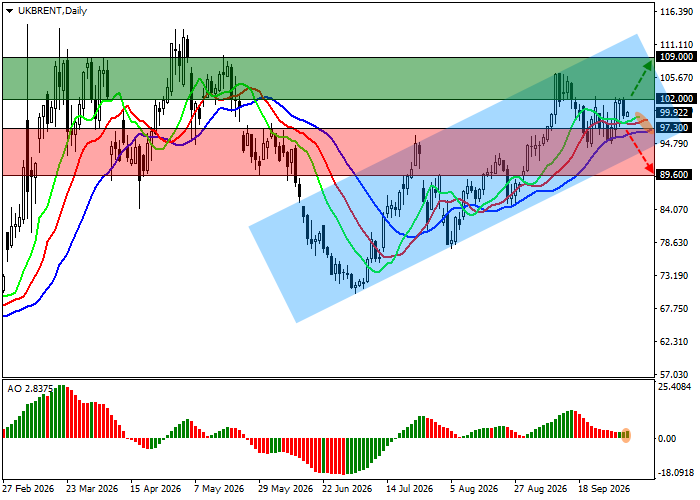
Brent Crude Oil trading scenarios and price forecast
Long positions may be opened after the price rises and consolidates above 102.00, with a target at 109.00. Stop-loss — 99.00. Implementation period: 7 days or more.
Short positions may be opened after the price declines and consolidates below 97.30, with a target at 89.60. Stop-loss — 101.00.
Scenario
| Timeframe | Weekly |
| Recommendation | BUY STOP |
| Entry point | 102.00 |
| Take Profit | 109.00 |
| Stop Loss | 99.00 |
| Key levels | 89.60, 97.30, 102.00, 109.00 |
Alternative scenario
| Recommendation | SELL STOP |
| Entry point | 97.30 |
| Take Profit | 89.60 |
| Stop Loss | 101.00 |
| Key levels | 89.60, 97.30, 102.00, 109.00 |
