

Bank of Japan Board Member Kazuyuki Masu — previously among the more cautious voices on monetary policy adjustment — has now aligned with his colleagues, stating that interest rates should be raised promptly given the absence of any clear signs of economic slowdown. Since the beginning of the month, Japanese financial authorities have conducted several currency interventions to support the yen, achieving only short-lived results as expectations for Federal Reserve tightening have begun to build. On May 12, Finance Minister Satsuki Katayama held talks with her US counterpart Scott Bessent, after which she confirmed strong coordination between the two countries on the currency market situation, signaling that Japan's interventions had received partner approval. Subsequent consultations between Bessent and Japan's Minister of Economy, Trade and Industry Ryosei Akazawa resulted in agreements to deepen cooperation in energy and critical minerals, while also confirming compliance with the White House's high tariff conditions.
Meanwhile, foreign bond purchases shifted from –¥887.7 billion to ¥2.406 trillion in April, while overseas investment in Japanese equities fell from ¥811.7 billion to ¥301.5 billion. Bond market dynamics are adding another headwind to any yen recovery: the yield on 30-year Japanese government bonds has risen from 3.697% to 3.842%, while the equivalent US yield has reached 5.000% for the first time since 2007, and the 10-year Treasury yield has hit a yearly peak of 4.49%.
The US dollar is holding at 98.90 on the USDX, maintaining elevated volatility amid President Donald Trump's visit to China, where he has already met with President Xi Jinping to discuss a range of key issues. Notably, China has agreed to purchase 200 Boeing aircraft for the first time in nearly a decade — though earlier media reports had suggested the deal could involve 500 or more units. Based on incoming macroeconomic data, a Fed rate hike could materialize in late summer or early autumn, though the CME FedWatch Tool does not yet confirm this timeline, pointing to a return to hawkish rhetoric only in September and pricing in a rate hold in the 3.50–3.75% range until then.
Support and Resistance Levels
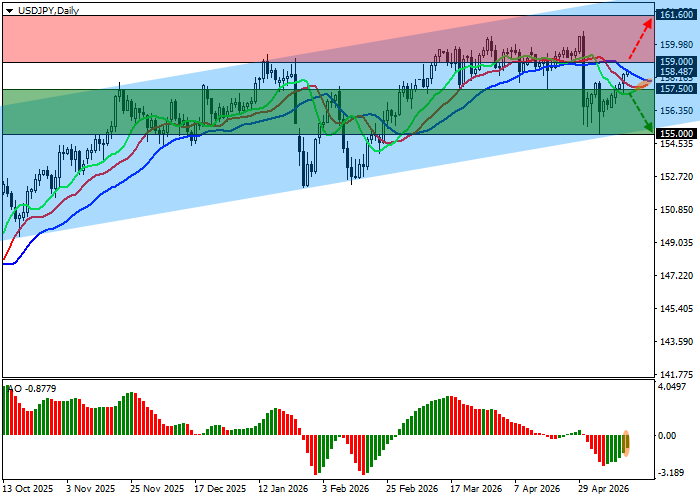
On the daily chart, the pair is moving within a downtrend, approaching the support line of a broad channel bounded by 161.00 and 156.00.
Technical indicators are easing their sell signal: the Alligator's fast EMAs are converging near the signal line, while the Awesome Oscillator histogram is forming corrective bars in negative territory.
Resistance levels: 159.00, 161.60.
Support levels: 157.50, 155.00.
USD/JPY Trading Scenarios and Price Forecast
Short positions can be opened after the price consolidates below 157.50, targeting 155.00, with a stop-loss at 158.50. Time horizon: 7 days or more.
Long positions can be opened after the price consolidates above 159.00, targeting 161.60, with a stop-loss at 158.00.
| Scenario | |
|---|---|
| Timeframe | Weekly |
| Recommendation | SELL STOP |
| Entry Point | 157.45 |
| Take Profit | 155.00 |
| Stop Loss | 158.50 |
| Key Levels | 155.00, 157.50, 159.00, 161.60 |
| Alternative Scenario | |
|---|---|
| Recommendation | BUY STOP |
| Entry Point | 159.05 |
| Take Profit | 161.60 |
| Stop Loss | 158.00 |
| Key Levels | 155.00, 157.50, 159.00, 161.60 |
