
The US Consumer Price Index accelerated to 3.8% against a forecast of 3.7%, while the core reading came in at 2.8% versus the expected 2.7% year-on-year. As a result, the Federal Reserve is unlikely to return to dovish monetary policy any time soon — according to the CME FedWatch Tool, the probability of the rate being held at 3.75% at the June 17 meeting stands at 99.4%. The Producer Price Index for April surged to 1.4% month-on-month, nearly three times the 0.5% forecast (with the previous reading revised upward from 0.5% to 0.7%), while the core PPI jumped to 1.0% against an expected 0.3% — a development that could accelerate consumer inflation and place further pressure on the Fed.
Data from the eurozone failed to offer the euro any meaningful support. April's Consumer Price Index rose from 2.6% to 3.0% year-on-year, driven primarily by a 10.9% surge in fuel prices, while first-quarter GDP expanded by just 0.1% quarter-on-quarter and 0.8% year-on-year — a stark contrast to the US figures of 0.5% and 2.7% respectively for the same period. Even growing expectations of a more hawkish ECB stance cannot offset the fundamental weakness. Eurozone industrial production remained flat at 0.2% in March, with the previous reading revised down from 0.4% to 0.2%. The eurozone economy simply lacks the drivers needed to generate positive momentum, and this is weighing directly on the single currency.
Investors are also digesting comments from ECB Chief Economist Philip Lane, who stated that the global oil crisis triggered by the US–Iran confrontation may require the central bank to raise interest rates in order to prevent fuel costs from becoming entrenched. Lane confirmed the position held by the majority of Governing Council members — that a temporary inflation spike will not lead to a significant policy adjustment — but acknowledged that a prolonged Middle Eastern conflict in the medium term would necessitate a return to hawkish rhetoric. He added that the demand destruction caused by rising energy costs does limit the extent of tightening ultimately required. According to a Reuters poll, most economists expect the ECB to raise its deposit rate next month and at least once more later in the year.
Support and Resistance Levels
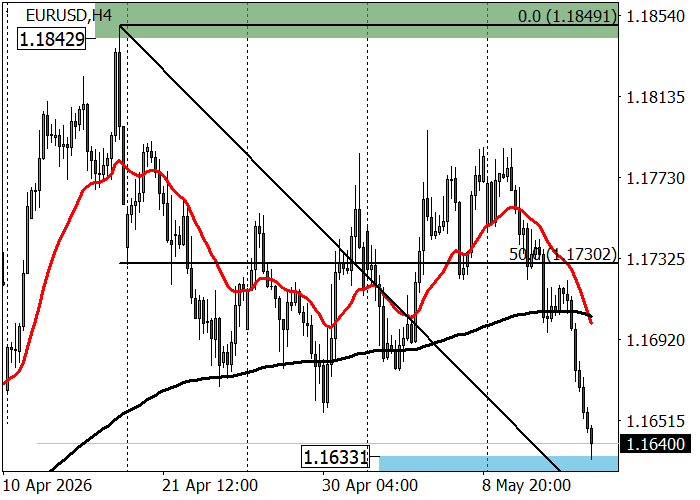
The long-term trend remains bullish, but this week's corrective move has taken price to a fresh low since April 30, reaching the support zone of 1.1650–1.1583. A reversal from this area would make long positions attractive targeting 1.1848–1.1796, while a breakdown below it would shift the trend to bearish, opening the way toward the 1.1443–1.1411 zone.
The medium-term trend is also upward, but the correction has brought price to the key support area of 1.1633–1.1611, from which bullish positions can be considered targeting 1.1730 and 1.1849. A failure to hold this zone would trigger a trend reversal to the downside, making short positions relevant with targets in zone 2 (1.1441–1.1421).
Resistance levels: 1.1796, 1.1848, 1.1927.
Support levels: 1.1649, 1.1583, 1.1443.
EUR/USD Trading Scenarios and Price Forecast
Long positions can be opened from 1.1615, targeting 1.1822, with a stop-loss at 1.1546. Time horizon: 9–12 days.
Short positions can be opened below 1.1546, targeting 1.1427, with a stop-loss at 1.1606.
| Scenario | |
|---|---|
| Timeframe | Weekly |
| Recommendation | BUY LIMIT |
| Entry Point | 1.1615 |
| Take Profit | 1.1822 |
| Stop Loss | 1.1546 |
| Key Levels | 1.1443, 1.1583, 1.1649, 1.1796, 1.1848, 1.1927 |
| Alternative Scenario | |
|---|---|
| Recommendation | SELL STOP |
| Entry Point | 1.1545 |
| Take Profit | 1.1427 |
| Stop Loss | 1.1606 |
| Key Levels | 1.1443, 1.1583, 1.1649, 1.1796, 1.1848, 1.1927 |
