

The euro is drawing support from an improvement in eurozone business activity. The Services PMI rose from 49.4 to 51.7 in July, returning to expansion territory, while the Composite PMI climbed from 50.0 to 52.0, slightly above the preliminary estimate of 51.9. The picture also improved in Germany, the bloc’s largest economy. The Services PMI increased from 48.6 to 49.8, indicating that the downturn had almost stabilised, while the Composite PMI moved from 49.5 to 51.3 and returned to growth.
Eurozone industrial producer prices declined by 0.3% month-on-month in June after rising by 0.2% previously. Annual growth slowed from 5.9% to 4.6%. The figures point to a gradual recovery in business activity and some easing of monthly price pressure, although inflation across the region remains above the European Central Bank’s 2.0% target.
This combination keeps the possibility of further ECB tightening on the table, but the decision will depend on whether stronger activity is accompanied by persistent consumer and wage inflation. The pair recently faced the same tension between growth and monetary policy when traders focused on the ECB inflation outlook. The US dollar, meanwhile, remains under pressure as renewed hopes of progress in negotiations over the Strait of Hormuz have encouraged demand for risk-sensitive assets.
US Treasury Secretary Scott Bessent and other administration officials suggested that an agreement involving Iran and Oman could be close. However, no final peace agreement or complete reopening of the strait had been formally confirmed, leaving the market vulnerable to sudden changes in geopolitical sentiment. Monetary policy expectations are also affecting the dollar. US inflation has remained above the Federal Reserve’s 2.0% target for several years, and some officials continue to argue that policy may need to become more restrictive.
Kansas City Fed President Jeff Schmid said inflation remained too high and that the current policy stance did not appear restrictive. In his view, bringing inflation back to the target would require tighter monetary policy. Still, this should not be interpreted as confirmation of an immediate rate increase, since future decisions will depend on incoming inflation, employment and growth data.
Support and Resistance Levels
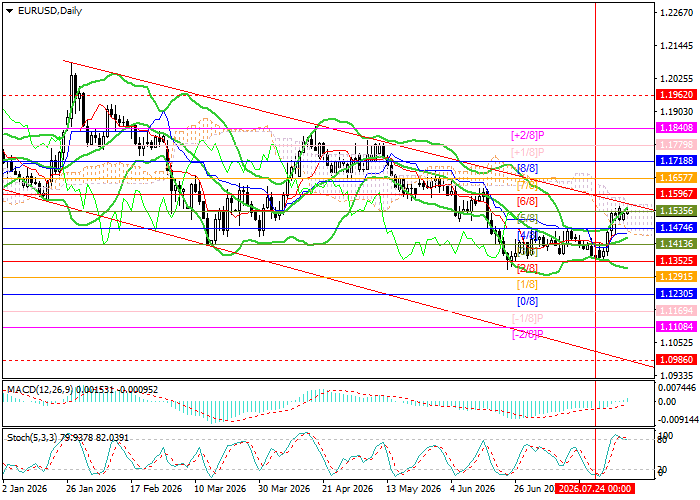
EUR/USD remains within a descending channel, although the price has staged a significant upward correction and is currently trading near 1.1535.
A breakout above 1.1596, the Murrey [6/8] level, could allow the pair to leave the channel and continue toward 1.1718, the Murrey [8/8] level, followed by 1.1840, the Murrey [+2/8] level, and 1.1962, the Murrey [+1/8] level on the weekly chart.
However, if the price consolidates below 1.1352, the Murrey [2/8] level, the decline could resume toward 1.1230, the Murrey [0/8] level, 1.1108, the Murrey [–2/8] level, and 1.0986, the Murrey [5/8] level on the weekly chart.
Technical indicators do not provide a unified signal. The Bollinger Bands are turning upward, the MACD histogram is expanding above the zero line, while the Stochastic Oscillator has entered the overbought zone and may reverse downward.
Resistance levels: 1.1596, 1.1718, 1.1840, 1.1962.
Support levels: 1.1352, 1.1230, 1.1108, 1.0986.
EUR/USD Trading Scenarios and Price Forecast
Long positions may be opened above 1.1596 with targets at 1.1718, 1.1840 and 1.1962 and a stop-loss at 1.1500. Time horizon: 5–7 days. Short positions may be opened below 1.1352 with targets at 1.1230, 1.1108 and 1.0986 and a stop-loss at 1.1440.
