
It should be recalled that in 2024 the financial authorities used this mechanism after the quotes reached 161.00. However, the renewed weakening of the national currency since late February, when the U.S.–Iran confrontation led to a sharp rise in energy prices, is putting unprecedented pressure on the Japanese economy, one of the most dependent on imported energy resources. Former Bank of Japan official Kazuo Momma believes that under the current conditions, the increase in borrowing costs planned for March and April will most likely have to be postponed.
At the same time, February inflation data showed a slowdown, confirming the effect of temporary utility subsidies, although fundamental risks remain relevant. The index excluding fresh food prices rose by 1.6% year-on-year, the lowest level since March 2022, and came in below the median economist forecast of 1.7%, while the headline indicator slowed to 1.3%. Despite the temporary easing, core inflation, including services, still remains above the 2.0% target at around 2.5%, signaling continued pressure on household budgets. The sharp increase in global oil prices, now 50.0% above pre-crisis levels, has already pushed gasoline prices to a record 190.8 yen per liter, heightening the risk of faster inflation by late spring. Economists at J.P. Morgan Securities expect that if crude oil remains near $100.0 per barrel, the core indicator could accelerate to 2.5% as early as May.
As for the current state of the debt market, bond yields are moving higher: one-year securities are trading near the highest level since 1985 at 1.145%, compared with 1.159% at the end of last week, 10-year bonds are yielding — 2.357%, up from 2.338% previously, while 20-year and 30-year bonds stand at — 3.283% and 3.761% versus 3.262% and 3.630%, respectively.
The top gainers in the index are JGC Holdings Corp. (+2.64%), Chugai Pharmaceutical Co., Ltd. (+1.71%), Japan Tobacco Inc. (+1.51%), Shin-Etsu Chemical Co., Ltd. (+0.93%), and Eneos Holdings Inc. (+0.56%).
Among the biggest decliners are SoftBank Group Corp. (–8.06%), Socionext Inc. (–7.63%), Taiyo Yuden Co., Ltd. (–7.68%), Shizuoka Financial Group Inc. (–6.96%), and Ibiden Co., Ltd. (–7.55%).
Support and resistance levels
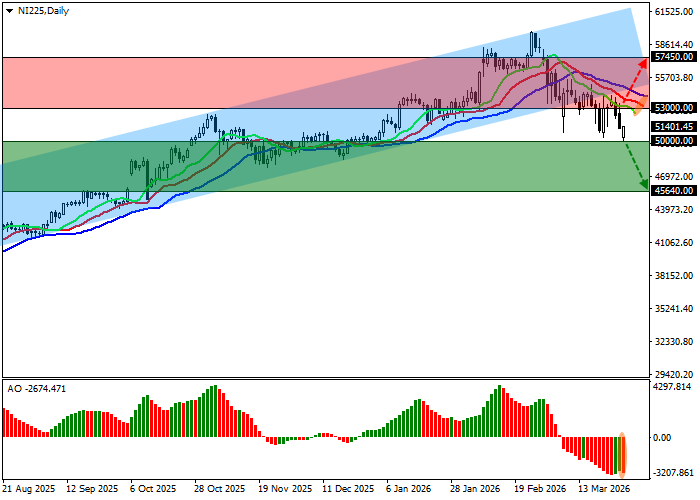
On the daily chart, the instrument is moving away from the support line of the ascending channel with dynamic boundaries of 61000.0–54000.0, heading toward this year’s low of 50390.0.
Technical indicators are preparing to strengthen the recently received sell signal: the fast EMAs on the Alligator indicator are widening their fluctuation range, while the AO histogram is forming new downward bars.
Support levels: 50000.0, 45640.0.
Resistance levels: 53000.0, 57450.0.
Trading scenarios and NI 225 forecast
Short positions may be opened after the price consolidates below 50000.0 with a target at 45640.0. Stop-loss — 51000.0. Timeframe: 7 days or more.
Long positions may be opened after the price consolidates above 53000.0 with a target at 57450.0. Stop-loss — 52000.0.
Scenario
| Timeframe | Weekly |
| Recommendation | SELL STOP |
| Entry point | 49999.5 |
| Take Profit | 45640.0 |
| Stop Loss | 51000.0 |
| Key levels | 45640.0, 50000.0, 53000.0, 57450.0 |
Alternative scenario
| Recommendation | BUY STOP |
| Entry point | 53000.5 |
| Take Profit | 57450.0 |
| Stop Loss | 52000.0 |
| Key levels | 45640.0, 50000.0, 53000.0, 57450.0 |
