

At its March 18 meeting, the Federal Reserve kept the interest rate unchanged at 3.75%, reflecting a moderately hawkish monetary stance. Policymakers highlighted persistent inflation above the 2.0% target and geopolitical tensions in the Middle East, which are driving higher energy prices, as key risks. Macroeconomic data released last week confirmed mixed conditions: the February Producer Price Index exceeded forecasts, indicating that companies are passing rising costs on to consumers, particularly in the services sector. At the same time, the revised estimate for fourth-quarter GDP growth was lowered to 0.7% annualized, roughly half the initial estimate. This week, investor attention will focus on inflation data, with the Personal Consumption Expenditures (PCE) Price Index scheduled for release on Friday at 14:30 (GMT+2). Economists expect the indicator to remain elevated, reinforcing expectations of continued hawkish rhetoric from the Fed.
Following the Bank of Canada’s latest meeting, the key interest rate was also left unchanged at 2.25%. Officials acknowledged risks associated with rising fuel prices; however, due to the interest rate differential, traders continue to apply carry trade strategies, which in the longer term contribute to gradual weakening of the Canadian dollar and strengthening of the US dollar.
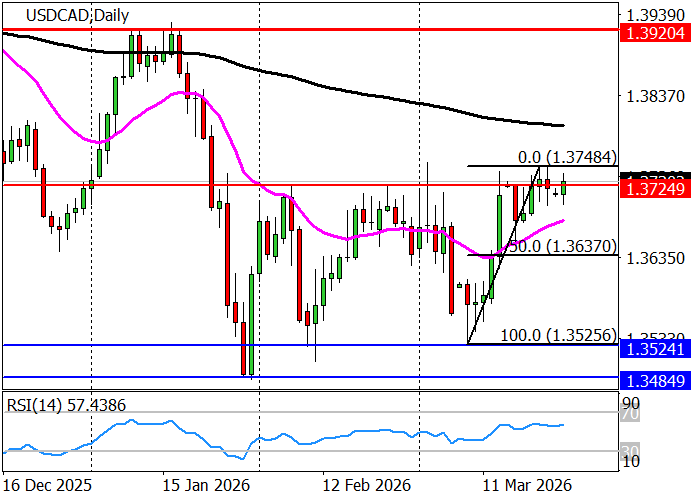
The long-term trend remains bearish: the price is currently testing the key resistance level at 1.3725, and a rejection from this level could lead to a move toward 1.3637 and 1.3525. However, a sustained breakout above this level would shift the trend to bullish, opening the way for long positions targeting 1.3920 (January high) and 1.4130 (November 2025 high). The pair is trading above the EMA (21) but below the EMA (190), indicating a short-term uptrend within a broader long-term downtrend, while the RSI (14) remains in neutral territory, allowing for positions in both directions.
The medium-term trend is upward: in early March, the asset corrected to the support zone of 1.3566–1.3548 before reversing and reaching 1.3650. Last week, prices approached the 1.3753 level, where remaining long positions may be partially closed. A continuation of upward momentum and consolidation above 1.3753 would open the path toward the next target zone at 1.3874–1.3855. However, in the event of a correction, a retest of the 1.3566–1.3548 support area is expected.
Support and resistance levels
Resistance levels: 1.3725, 1.3920, 1.4130.
Support levels: 1.3524, 1.3485, 1.3220.
Trading scenarios and USD/CAD forecast
Short positions may be considered below 1.3697 with targets at 1.3637 and 1.3525, and a stop-loss at 1.3750. Implementation period: 9–12 days.
Long positions may be considered above 1.3767 with a target at 1.3920 and a stop-loss at 1.3697.
Scenario
| Timeframe | Weekly |
| Recommendation | SELL STOP |
| Entry point | 1.3695 |
| Take Profit | 1.3637, 1.3525 |
| Stop Loss | 1.3750 |
| Key levels | 1.3220, 1.3485, 1.3524, 1.3725, 1.3920, 1.4130 |
Alternative scenario
| Recommendation | BUY STOP |
| Entry point | 1.3770 |
| Take Profit | 1.3920 |
| Stop Loss | 1.3697 |
| Key levels | 1.3220, 1.3485, 1.3524, 1.3725, 1.3920, 1.4130 |
