

According to Binance Research, Bitcoin’s weak performance may have less to do with the crypto market itself and more with what is happening in equities. Analysts point to the CBOE Dispersion Index, which recently rose to 42 points — the third-highest level ever recorded. This suggests that capital is becoming heavily concentrated in a small number of areas within the S&P 500.
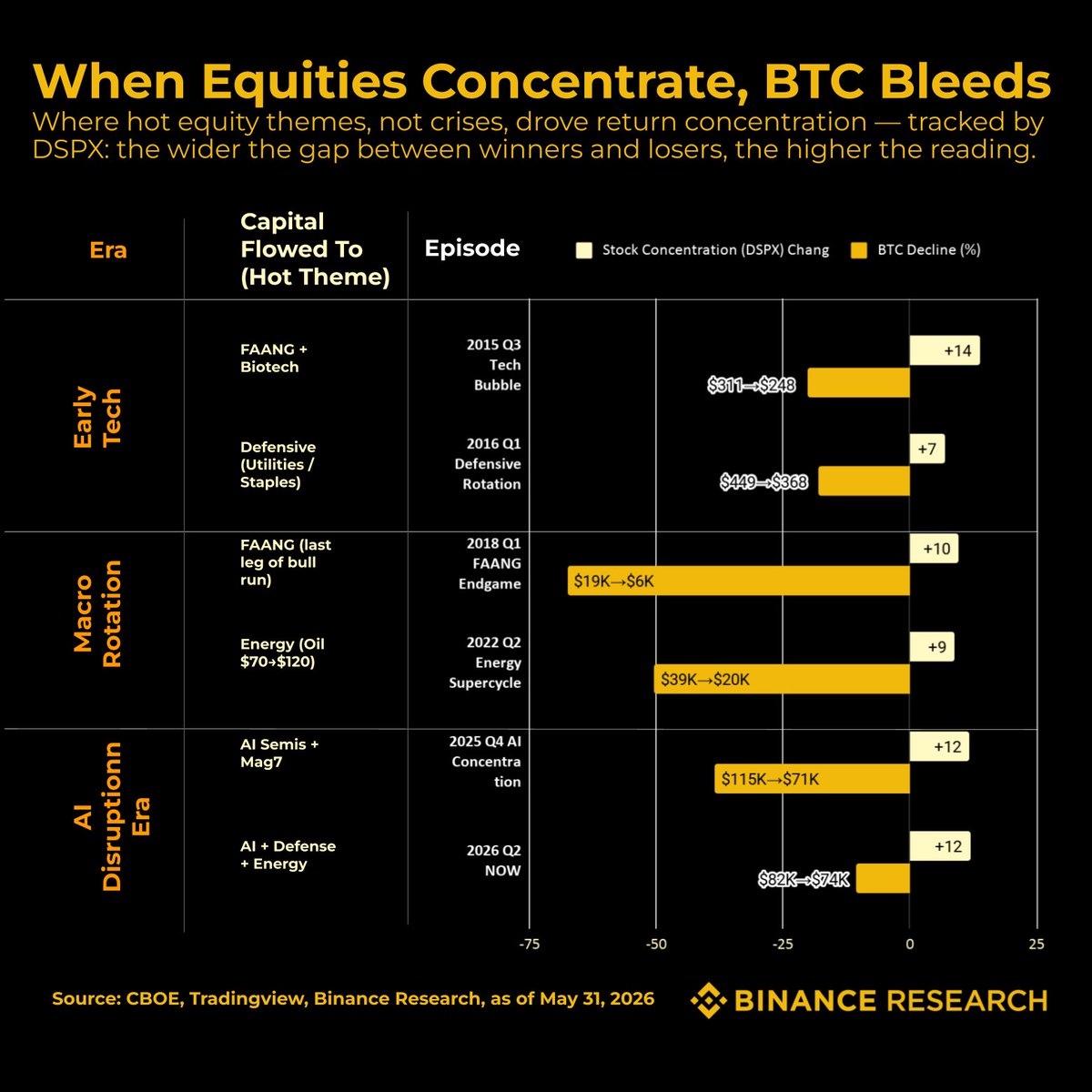
Binance Research believes this concentration is pulling investor money into the most attractive stock market segments, leaving less liquidity available for Bitcoin. In other words, capital is being absorbed by strong equity themes, putting additional pressure on BTC.
Historically, there have been similar periods when large capital rotations into the stock market coincided with Bitcoin weakness. Analysts mention the shift into technology and biotech stocks in 2015, the late-stage tech cycle in 2018, and strong demand for energy stocks in 2022.
This time, the rotation appears especially strong. Money is flowing into artificial intelligence companies, defense stocks, the energy sector, and commodities. As a result, Bitcoin is losing attention on several fronts at once.
Still, Binance Research does not see this as a sign of internal weakness in the crypto market. The current pressure appears to be driven mainly by external capital flows rather than by Bitcoin-specific or crypto-native problems.
Historical data also shows that BTC has recovered after previous periods of heavy capital concentration in equities. In similar situations, Bitcoin usually found a bottom within a few weeks before starting a new upward move.
Bitcoin’s weakness appears to be driven more by external capital flows than by internal crypto market problems. If money continues moving into high-demand stock sectors, BTC may remain under pressure, although previous cycles show that Bitcoin often recovers after such liquidity rotations.
