

The prolonged downward movement in cryptocurrency prices is explained by a structural redistribution of capital: according to Tom Lee, co-founder of research firm Fundstrat Global Advisors and head and blockchain lead at BitMine Immersion Technologies Inc., significant volumes of stock market capital are now concentrated in the largest technology companies, including Google LLC, Space Exploration Technologies Corp., OpenAI, Anthropic, and Meta Platforms Inc. Additional pressure on risk assets comes from ongoing geopolitical tensions in the Middle East, which are contributing to a reduction in investments in more volatile instruments. However, despite the current correction, Lee believes that the increasing complexity of models may stimulate broader blockchain adoption, primarily in payments, identity, and decentralized computing systems. In addition, inflation in the United States is accelerating actively, increasing the likelihood of tighter monetary conditions and supporting the dollar: according to May data, the consumer price index slowed from 0.6% to 0.5% month-on-month, while year-on-year it rose from 3.8% to 4.2%, reaching its highest level since the beginning of 2023, while the core index changed from 0.4% to 0.2% and from 2.8% to 2.9%, respectively.
Investors are focusing on regulation of the crypto sector. In the United States, the public movement Stand With Crypto, together with more than 200 organizations, sent a letter to the Senate calling for the Clarity Act, a bill intended to establish clear rules for the crypto industry, to be brought to a full chamber vote. The signatories — from major exchanges and funds to infrastructure projects — stated that the industry is consolidating around the idea of creating clear rules for regulating the crypto sector in the United States and emphasized that the bill’s passage through the Banking Committee was an important political signal for the market. It has already been supported by key industry associations, including the Blockchain Association, the Crypto Council for Innovation, and The Digital Chamber, while the list of signatories includes major market participants such as Coinbase, Kraken, Binance.US, Circle, and Ripple, as well as venture funds Andreessen Horowitz (a16z), Paradigm, Multicoin Capital, and Portal Ventures. Infrastructure players also joined the initiative, including Uniswap, Aave Labs, ENS, Alchemy, Anchorage Digital, Hedera, Injective, Jito Labs, Filecoin Foundation, Solana Policy Institute, Elliptic, and MARA, reflecting broad industry consensus on the need for legal certainty. At the same time, discussion is intensifying around the status of developers and network infrastructure participants.
Kristin Smith, head of the Solana Policy Institute, emphasizes that creators of open-source software and non-custodial wallets, as well as validators, should not be classified as financial intermediaries because they do not control user funds and do not conduct transactions on users’ behalf. At the same time, the regulatory agenda is strengthening at the state level. The New York State Department of Financial Services (NYDFS) proposed expanding existing requirements for stablecoin issuers, including mandatory 1:1 backing of tokens with the U.S. dollar, immediate redemption upon request, and regular independent reserve audits. In addition, the regulator insists on implementing comprehensive risk management systems, including internal controls, cybersecurity, audits, monitoring of transactions and operations with affiliated parties, as well as a mechanism for dual reserve confirmation by management and independent auditors. For issuers with circulation above 25.0 billion dollars, limits are proposed on the concentration of reserves with a single custodian, along with a requirement to place at least 0.5% of their volume, but no more than 500.0 million dollars, in insured depository institutions.
In European jurisdictions, the regulatory approach also points to adaptation to the growing institutionalization of the market. The U.K. Financial Conduct Authority (FCA) is preparing to allow retail investment funds to invest up to 10.0% of their assets in crypto ETNs — exchange-traded notes linked to digital assets. The initiative is aimed at gradually aligning access regimes for different categories of investors after the liberalization of the retail crypto ETN segment. In parallel, the Bank of England and the FCA are forming a comprehensive regulatory framework for stablecoins, custody, and staking, balancing innovative competition with financial stability requirements.
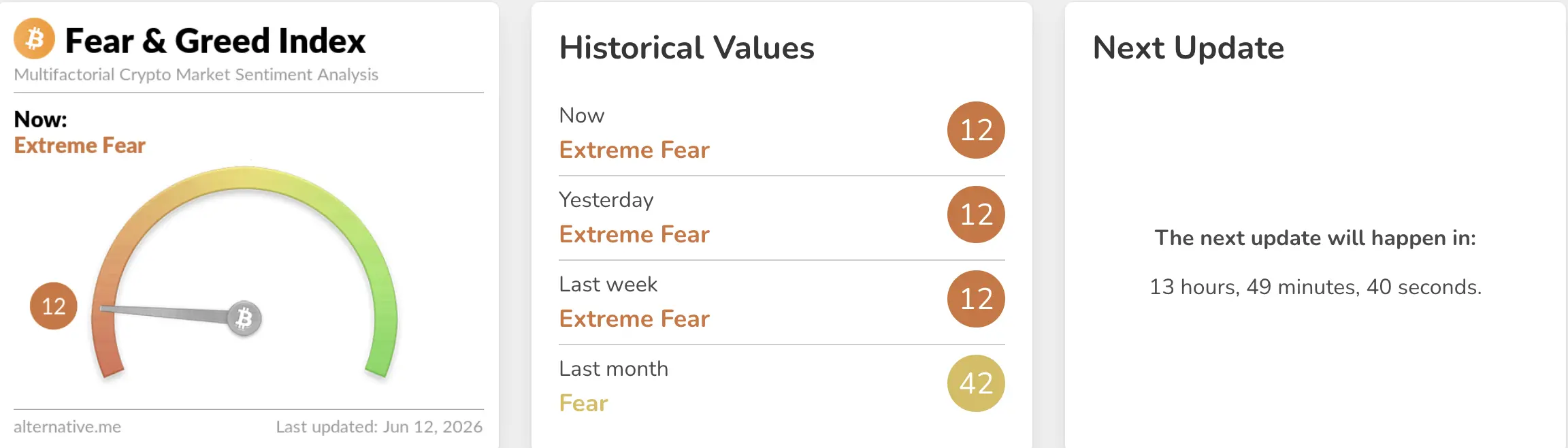
Taken together, these factors create an environment of heightened sensitivity to changes in liquidity and regulatory expectations. The Fear and Greed Index remains at 12 in the “strong fear” zone, reflecting a phase of structural caution among market participants and the absence of stable drivers for a reversal of the downtrend in the short term.
