

First, investors are assessing the risk of a potential shutdown of the U.S. federal government amid intensifying domestic political tensions. On Saturday, Senate Democratic leader Chuck Schumer said he was ready to block a vote on a government funding bill unless substantial changes were made to domestic security regulations, following an incident in Minneapolis where Immigration and Customs Enforcement (ICE) officers used firearms against medical worker Alex Pretti. The bill regulating funding for the Department of Homeland Security (DHS) is one of six measures forming a broader package covering about $1.3 trillion in annual spending. A new shutdown could reduce market liquidity and, as a result, weaken investor interest in risk assets.
On Wednesday at 21:00 (GMT+2), market participants will focus on the outcome of the first Federal Reserve meeting of the year. Most analysts expect interest rates to remain unchanged in the 3.50–3.75% range, as recent data show the U.S. economy is recovering strongly (GDP grew by 4.4% in the third quarter of last year), the labor market remains stable (the unemployment rate fell from 4.5% to 4.4% in December), and inflation is still above the regulator’s target, standing near 2.7% in December. However, policymakers’ rhetoric may signal future steps, and a prolonged pause in the easing cycle cannot be ruled out due to persistent inflation risks. Such an approach could add pressure on assets alternative to the dollar, including global currencies, emerging-market bonds, commodities, and cryptocurrencies, while increasing short-term volatility.
Finally, the delay in passing the Crypto Market Structure and Transparency Act (CLARITY) continues to weigh on digital asset prices. The initiative, aimed at formalizing crypto regulations and increasing market transparency, has yet to receive U.S. Senate approval. Major crypto industry players have raised serious objections, warning of excessive regulation and tighter administrative control over exchanges and token issuers. Amid ongoing legislative uncertainty, market sentiment remains negative. Over the past four trading sessions, Bitcoin ETF balances fell by $1.324 billion, while the Fear & Greed Index dropped to 20, returning to the “extreme fear” zone, signaling dominant bearish sentiment and elevated volatility.
Support and Resistance Levels
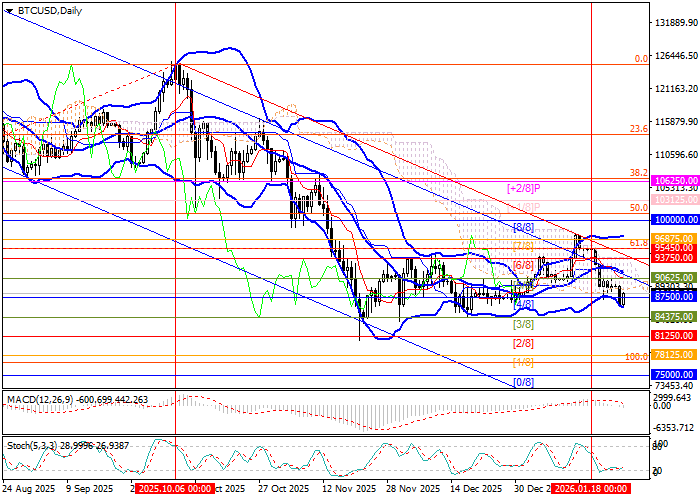
Technically, the instrument has returned to a descending channel and is attempting to consolidate below 87,500.00 (Murray level [4/8]). If successful, further downside toward 81,250.00 (Murray [2/8]) and 75,000.00 (Murray [0/8]) may follow. The key level for bulls is 93,750.00 (Murray [6/8]); a breakout above it would open the way toward 100,000.00 (Murray [8/8]) and 106,250.00 (Murray [+2/8], 38.2% Fibonacci retracement).
Technical indicators support the bearish scenario: Bollinger Bands are turning downward, the MACD histogram has moved into negative territory, and the Stochastic oscillator is flat near oversold levels.
Resistance levels: 93,750.00, 100,000.00, 106,250.00.
Support levels: 87,500.00, 81,250.00, 75,000.00.
Trading Scenarios and Bitcoin Price Forecast
Short positions may be opened from 86,500.00 with targets at 81,250.00 and 75,000.00, and a stop-loss at 89,000.00. Time horizon: 5–7 days.
Long positions may be considered above 93,750.00 with targets at 100,000.00 and 106,250.00, and a stop-loss at 90,000.00.