

A New Tiered Model for Crypto Investor Access
Under the draft proposal, access to cryptocurrencies would be split into tiers for qualified and non-qualified investors. As Bloomberg reports, both categories would be allowed to participate, but under different conditions. A core element of the framework is mandatory investor testing before gaining access to crypto transactions.
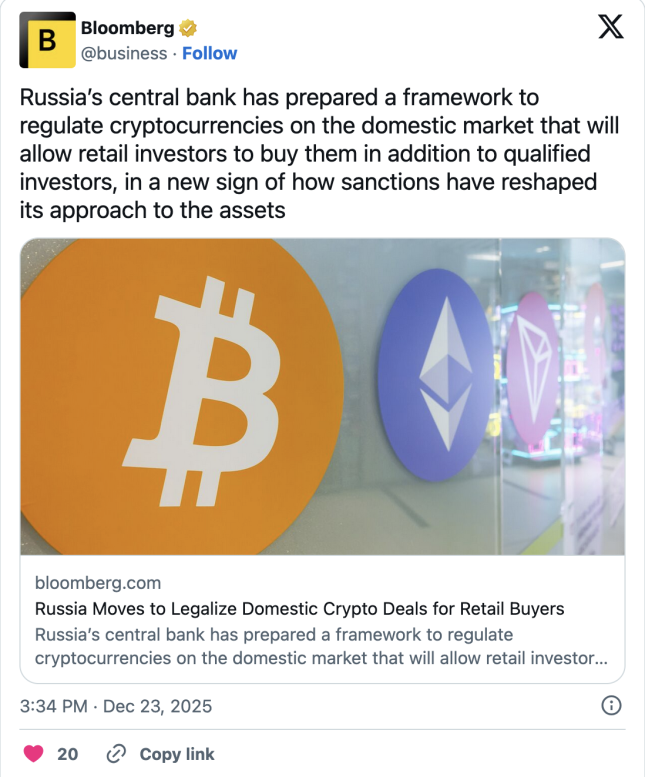
For non-qualified investors, the rules would be especially strict. Retail participants would be allowed to buy only a limited list of the most liquid cryptocurrencies, although the specific list has not yet been published. In addition, they would need to pass a basic test covering risk awareness.
The annual investment cap for retail participants would be set at 300,000 rubles (about 3,800$), and all transactions would have to be routed through a single licensed intermediary.
Qualified investors would receive far more flexibility: they would be permitted to purchase most cryptocurrencies without volume limits, provided they complete an extended risk-awareness test. However, anonymous and privacy-focused tokens (privacy coins) would not fall under the unrestricted-access regime.
The draft framework and related legislative amendments have already been submitted to the government. A full launch is scheduled for July 1, 2026, although enforcement and supervision mechanisms are still being developed.
Crypto Trading Inside a Licensed Financial System
The Bank of Russia’s initiative is designed to move crypto activity into a supervised environment. If adopted, trading would be permitted only through licensed exchanges, brokers, and trust managers. Separate standards are also planned for custodians and trading platforms.
Intermediaries serving non-qualified investors would face additional obligations, including client identification, enhanced risk disclosures, cybersecurity standards, and segregation of client assets. These requirements raise the barrier to entry and, in practice, favour larger financial institutions.
At the same time, Russian residents would not be prohibited from buying cryptocurrencies abroad via foreign accounts and overseas exchanges. However, such transactions would need to be declared to the tax authorities.
Separately, the regulator has allowed for the possibility of digital financial assets circulating on public blockchains, which could potentially be used to attract foreign capital. At the same time, cryptocurrency would retain the status of an investment asset only, not a means of payment.
The central bank stresses that its overall stance remains cautious: cryptocurrencies are still viewed as high-risk instruments due to volatility, the absence of issuer guarantees, and sanctions-related exposure.
Sanctions as a Catalyst for Policy Change
The new concept extends a gradual reassessment of Russia’s crypto policy under sanctions pressure. In early 2022, the Bank of Russia advocated a full ban on cryptocurrencies, comparing them to financial pyramid schemes and a threat to stability.
However, after restrictions limited access to international banking networks, digital assets began to be used more actively for cross-border settlements by individuals and companies alike, even without clear rules.
In 2024, authorities permitted crypto use in foreign trade operations, and banks received approval to offer limited crypto-related services. Cryptocurrency mining was also legalized, with the central bank recognizing it as an export activity rather than a systemic risk.
Domestic crypto payments remain prohibited: all payments inside Russia must be made exclusively in rubles.
The proposed model is not intended to encourage mass adoption of crypto assets, but to systematize an already existing practice. By separating investor categories, imposing limits on retail access, and restricting anonymous tokens, the regulator aims to keep the market within a transparent and controlled framework.
Overall, Russia is moving from a policy of bans to regulated participation in the crypto market. The new access regime covers investor requirements, transaction limits, and licensed intermediaries, and is expected to be implemented by mid-2026 under strict supervision.