

Recall that last week the U.S. regulator, as expected, cut the interest rate by 25 basis points to 3.75% and maintained its projections for 2026, implying one more adjustment of a similar magnitude. At the same time, officials believe that GDP growth will accelerate and that the pace of inflation deceleration will increase. Investors are also assessing labor-market data: in November, nonfarm payrolls totaled 64.0K, better than the expected 50.0K, following –105.0K previously due to the record 43-day government shutdown, while the overall unemployment rate accelerated from 4.4% to 4.6%. Incoming statistics increase the likelihood that the Fed will retain a dovish tone next year. At 15:30 (GMT+2), the Consumer Price Index will be released; according to preliminary estimates, core CPI will remain at 3.0% year-on-year, while the broader measure will rise from 3.0% to 3.1%. At the same time, updated labor-market information will be published: initial jobless claims may change from 236.0K to 225.0K, while continuing claims may rise from 1.838M to 1.94M.
Meanwhile, the yuan received support after the People’s Bank of China published its fiscal and monetary plans for 2026. Authorities intend to pursue a “loose monetary policy” and strengthen overall control to support the economy. In addition to traditional interest-rate cuts, policymakers highlighted the possibility of revising banks’ required reserve ratios and optimizing certain expenditures. They also stated they would provide targeted support to the real-estate market in order to achieve a noticeable reduction in both visible and hidden risks. Officials also intend to stimulate domestic demand, which has recently shown a negative trend: retail sales growth slowed from 2.9% to 1.3%, significantly worse than neutral forecasts. After President Xi Jinping warned of factors that could slow the recovery, fixed-asset investment registered a third consecutive adjustment to –2.6% year-on-year versus Bloomberg analysts’ estimate of –2.3% and October’s –1.7%, underscoring the need for active measures to stabilize key areas such as infrastructure, real estate, and high-tech manufacturing.
Support and resistance levels
On the daily chart, Bollinger Bands are falling steadily: the price range is expanding to the downside, giving bears room to push to fresh lows. The MACD indicator maintains a sell signal (the histogram is below the signal line), while Stochastic is hovering near its minimum values, pointing to risks of the U.S. dollar being oversold in the very short term.
Resistance levels: 7.0422, 7.0475, 7.0532, 7.0636.
Support levels: 7.0306, 7.0200, 7.0100, 7.0000.
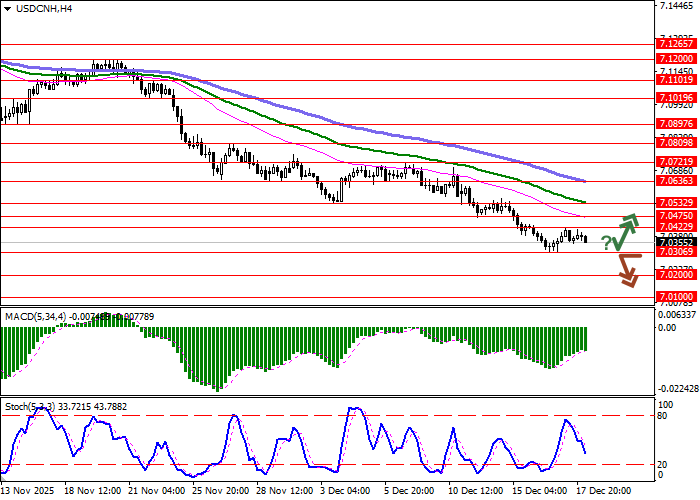
Trading scenarios and USD/CNH forecast
Short positions can be opened after a confident downside breakout below 7.0306, targeting 7.0100. Stop-loss: 7.0422. Time horizon: 1–2 days.
Long positions can be opened after a rebound from 7.0306 and a breakout above 7.0422, targeting 7.0636. Stop-loss: 7.0306.
Scenario
| Timeframe | Intraday |
| Recommendation | SELL STOP |
| Entry point | 7.0305 |
| Take Profit | 7.0100 |
| Stop Loss | 7.0422 |
| Key levels | 7.0000, 7.0100, 7.0200, 7.0306, 7.0422, 7.0475, 7.0532, 7.0636 |
Alternative scenario
| Recommendation | BUY STOP |
| Entry point | 7.0425 |
| Take Profit | 7.0636 |
| Stop Loss | 7.0306 |
| Key levels | 7.0000, 7.0100, 7.0200, 7.0306, 7.0422, 7.0475, 7.0532, 7.0636 |