

This outcome grants Prime Minister Sanae Takaichi institutional freedom to implement her economic and fiscal program without interparty negotiations or mandatory approval from the House of Councillors, while also creating favorable conditions for further monetary policy normalization by the Bank of Japan. Against this backdrop, analysts at Bank of America Securities revised their medium-term rate outlook, raising the terminal rate forecast to 1.75% by 2027 from the previous estimate of 1.50%.
According to the updated projection, the first rate adjustment could occur as early as the April meeting, with the baseline scenario implying sequential 25-basis-point hikes in September, followed by January and June 2027, supported by macroeconomic stabilization and inflation gradually converging toward the 2.0% target.
An additional factor is the relative stabilization of the yen compared to the beginning of the year, reducing the likelihood of currency intervention and allowing the regulator to influence the foreign exchange market primarily through monetary tools. Although Finance Minister Satsuki Katayama previously confirmed that part of Japan’s $1.4 trillion foreign reserves could be used to cover a potential budget deficit—estimated to rise by about 5.0 trillion yen annually due to the proposed 8.0% sales tax cut on food products—no final decision on this mechanism has yet been made.
The US dollar has remained under pressure since the start of the week, with the index hovering near 96.5 points, down from the recent high of 97.80. This reflects a reassessment of market expectations regarding the US economic outlook and the Federal Reserve’s next steps. Amid a shifted data release schedule, investors are focusing on retail sales dynamics: in December, the monthly figure stood at 0.6%, while the annual rate slowed from 3.26% to 2.43%, confirming a gradual cooling in demand. Core retail sales showed zero growth after a previous 0.4% increase. Meanwhile, inventories rose by 0.1% month-on-month, and against declining sales volumes, this points to persistent structural imbalances in the retail sector.
Support and Resistance Levels
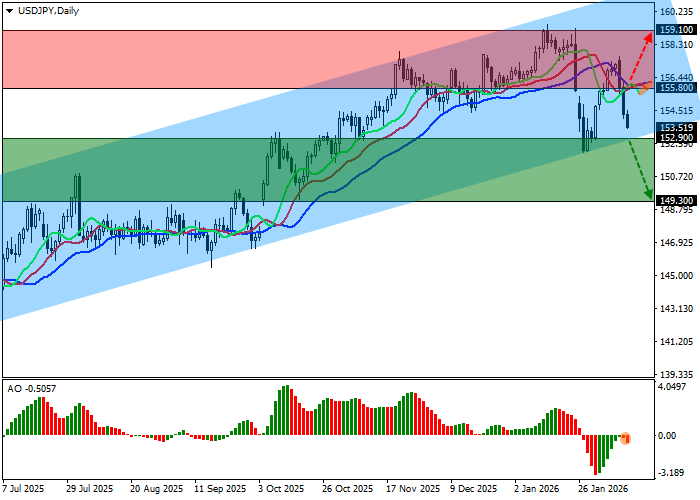
On the daily chart, the instrument is correcting within a broader downtrend, approaching the lower boundary of the 160.00–152.50 channel.
Technical indicators have reversed and generated a new sell signal: the fast EMAs of the Alligator indicator are diverging from the signal line, while the AO histogram is forming new corrective bars below the zero line.
Support levels: 152.90, 149.30.
Resistance levels: 155.80, 159.10.
Trading Scenarios and USD/JPY Forecast
Short positions may be opened after a confirmed break below 152.90, targeting 149.30. Stop-loss: 155.00. Implementation period: 7 days or more.
Long positions may be considered after a confirmed break above 155.80, targeting 159.10. Stop-loss: 154.00.
Scenario
| Timeframe | Weekly |
| Recommendation | SELL STOP |
| Entry Point | 152.85 |
| Take Profit | 149.30 |
| Stop Loss | 155.00 |
| Key Levels | 149.30, 152.90, 155.80, 159.10 |
Alternative Scenario
| Recommendation | BUY STOP |
| Entry Point | 155.85 |
| Take Profit | 159.10 |
| Stop Loss | 154.00 |
| Key Levels | 149.30, 152.90, 155.80, 159.10 |