
As such operations are typically avoided during periods of low volatility due to the risk of uncontrolled exchange-rate swings, Swiss authorities refrained from taking radical measures in December. Analysts broadly agree that the decision threshold lies near the 0.7800 level. Strategists at Swiss financial group UBS expect USD/CHF to stabilize around this level in the first quarter, while EUR/CHF is projected at 0.9400, effectively confirming the possibility of intervention mechanisms being deployed in the near future to stabilize the national currency.
This assessment is supported by the current monetary policy stance of the European Central Bank (ECB), which for the fourth consecutive meeting kept its policy parameters unchanged: the deposit rate near 2.00%, the marginal lending facility at 2.40%, and the key rate at 2.15%. Eurozone inflation remains close to the 2.0% target, allowing the SNB to pause further adjustments at its upcoming meeting and, at least once, maintain borrowing costs at zero in order to avoid creating imbalances.
There is also a high probability that the U.S. Federal Reserve will pause its dovish cycle. According to the CME FedWatch Tool, 83.4% of market participants expect the rate to be held in the 3.50–3.75% range, making SNB interventions appear less urgent. In addition, a new Fed chair will take office in May, potentially backing the Republican administration’s push to reassess monetary conditions. One of the leading candidates is White House economic adviser Kevin Hassett, a consistent supporter of President Donald Trump’s policy agenda.
A positive driver for the U.S. dollar last Friday was the manufacturing PMI report, which edged down from 52.2 to 51.8 points but remained in expansion territory. Importantly, expectations for key macro indicators remain constructive. U.S. GDP growth is forecast at 1.7% in 2025 (0.1 percentage points above the September estimate), 2.3% in 2026 (versus a prior estimate of 1.8%), and revised upward from 1.9% to 2.0% in 2027. Inflation is projected at 2.9%, 2.4%, and 2.1%, respectively.
Support and resistance levels
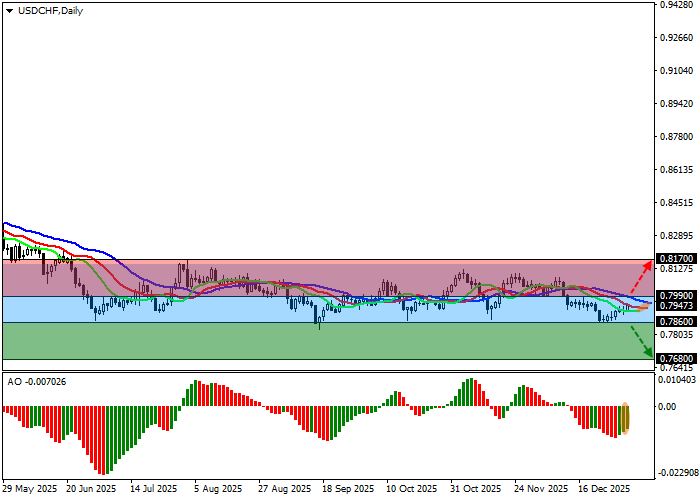
On the daily chart, the pair remains above the support line of a sideways channel with dynamic boundaries at 0.8150–0.7860.
Technical indicators turned lower in early December, generating a sell signal: the fast EMAs on the Alligator indicator are moving away from the signal line, while the AO oscillator histogram is below the zero line, forming new corrective bars.
Support levels: 0.7860, 0.7680.
Resistance levels: 0.7990, 0.8170.
Trading scenarios and USD/CHF outlook
Short positions may be opened after a firm break below 0.7860, with a target at 0.7680. Stop-loss — 0.7940. Time horizon: 7 days or more.
Long positions may be considered after a sustained move above 0.7990, targeting 0.8170. Stop-loss — 0.7920.
Scenario
| Timeframe | Weekly |
| Recommendation | SELL STOP |
| Entry point | 0.7860 |
| Take Profit | 0.7680 |
| Stop Loss | 0.7940 |
| Key levels | 0.7680, 0.7860, 0.7990, 0.8170 |
Alternative scenario
| Recommendation | BUY STOP |
| Entry point | 0.7990 |
| Take Profit | 0.8170 |
| Stop Loss | 0.7920 |
| Key levels | 0.7680, 0.7860, 0.7990, 0.8170 |