

The weakening of the currency, which has contributed to rising domestic inflationary pressure, became a key argument for the regulator in discussions with the government of Prime Minister Sanae Takaichi, a supporter of a “dovish” monetary policy approach. This dialogue resulted in an interest rate hike on December 19 from 0.50% to 0.75%. However, uncertainty regarding further tightening continues to restrain a recovery in the yen’s position. Earlier, in an interview with Japanese media, Ken Kobayashi, head of the national Chamber of Commerce and Industry, stated that the current trend is already driving up the cost of imported raw materials for small and medium-sized businesses. According to him, a weak national currency remains one of the key reasons behind rising prices, which is why the government and the Bank of Japan need to support entrepreneurs who depend on foreign supplies.
Meanwhile, by the end of 2025, amid a shift in investor sentiment regarding the future policy stance of the U.S. Federal Reserve, the U.S. dollar index (DXY) had lost approximately 10.4%. Recall that the regulator adjusted borrowing costs three times, and the rate is now held in the 3.50–3.75% range. Market experts are confident that officials will pause the “dovish” cycle at the upcoming January 29 meeting, which undoubtedly supports the U.S. currency. The probability of such an outcome is currently estimated at 83.4%, according to the Chicago Mercantile Exchange (CME) FedWatch Tool, compared with around 66.2% just a month ago. An additional factor supporting the dollar is the political regime change in Venezuela. On January 3, U.S. armed forces carried out a series of airstrikes on military and civilian targets in Caracas, after which reports emerged of the arrest of President Nicolás Maduro and his wife Cilia Flores. They were later escorted to a detention facility in Brooklyn, where they may already face charges related to narco-terrorism and weapons possession. The Venezuelan government called the actions of U.S. authorities an “act of imperialist aggression,” declared a state of emergency, and reaffirmed that it continues to recognize Maduro as the country’s legitimate head of state.
Support and Resistance Levels
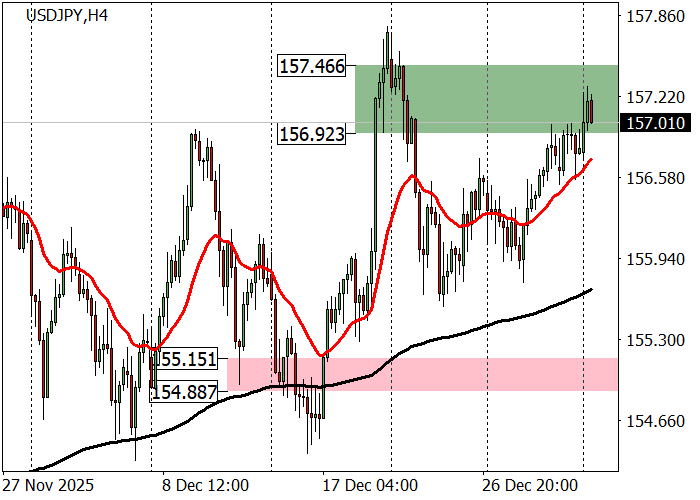
The long-term trend remains bullish: last week the price reached the resistance level of 156.92 but failed to break through it. If successful, the next target would be last year’s January high at 158.88, followed by 163.93. If bears manage to hold the 156.92 resistance, a correction toward the 154.80 area is likely, from where new long positions could be considered with a target at 152.92.
The medium-term trend is also bullish: for more than a month, the price has been trading within a narrow range between resistance zones (157.46–156.92) and support zones (155.15–154.88). A breakout above the resistance zone would extend gains toward zone 4 (163.22–162.64). Otherwise, USD/JPY quotes may resume a correction toward the 155.15–154.88 area, from where long positions could be considered with a target at the local high of 157.89.
Resistance levels: 156.92, 158.88, 161.93.
Support levels: 154.80, 152.98, 150.20.
Trading Scenarios and USD/JPY Forecast
Long positions should be opened above the 156.92 level with a target at 158.88 and a stop-loss at 156.22. Time horizon: 9–12 days.
Short positions should be opened below the 154.30 level with a target at 152.30 and a stop-loss at 155.20.
Scenario
| Timeframe | Weekly |
| Recommendation | BUY STOP |
| Entry point | 156.95 |
| Take Profit | 158.88 |
| Stop Loss | 156.22 |
| Key levels | 150.20, 152.98, 154.80, 156.92, 158.88, 161.93 |
Alternative scenario
| Recommendation | SELL STOP |
| Entry point | 154.25 |
| Take Profit | 152.30 |
| Stop Loss | 155.20 |
| Key levels | 150.20, 152.98, 154.80, 156.92, 158.88, 161.93 |