

Experts attribute the currency’s dynamics to a high probability of market intervention by the Bank of Japan, as well as uncertainty surrounding the financing of Prime Minister Sanae Takaichi’s expansionary fiscal policy. Analysts believe that the discussed increase in the tax burden could lead to a further rise in public debt, which already exceeds 260.0% of gross domestic product (GDP)—the highest level among developed economies. Rising fiscal pressure ahead of the elections increases the likelihood of a widening budget deficit, which reached 6.0–7.0% of GDP in the previous fiscal year, negatively affecting the bond market. Yields on key 10-year government bonds have fluctuated around 0.9–1.0% in recent weeks, and any signals of increased borrowing would push yields higher, reducing bond attractiveness and increasing yen volatility. The election is scheduled for February 8; according to analysts’ estimates and opinion polls, Takaichi is likely to remain in office, reducing political uncertainty but not eliminating fiscal risks.
In the near-term market dynamics, a downward correction persists, reinforced by weak macroeconomic indicators: economic growth stands at 0.5–0.7% year-on-year, inflation is easing from recent peaks above 3.0% toward the 2.0% target, and consumer activity is showing signs of cooling. In December, the household spending index fell from 6.2% to –2.9%, below forecasts of –1.3% month-on-month, and from 2.9% to –2.6% year-on-year versus expectations of –0.5%.
The positive momentum of the US dollar, which began earlier this week, continues, with the USDX holding near 97.60. As expected, traders’ focus has shifted to macroeconomic data released with some delay after President Donald Trump approved funding for federal government agencies on Tuesday, ending a partial shutdown. In December, job openings according to JOLTS declined from 6.928 million to 6.542 million—the lowest level since January 2021 during the COVID-19 pandemic. Initial jobless claims rose from 209.0 thousand to 231.0 thousand versus expectations of 212.0 thousand, continuing claims increased from 1.819 million to 1.844 million, slightly below forecasts of 1.850 million, while the four-week average rose from 206.25 thousand to 212.25 thousand.
Support and resistance levels
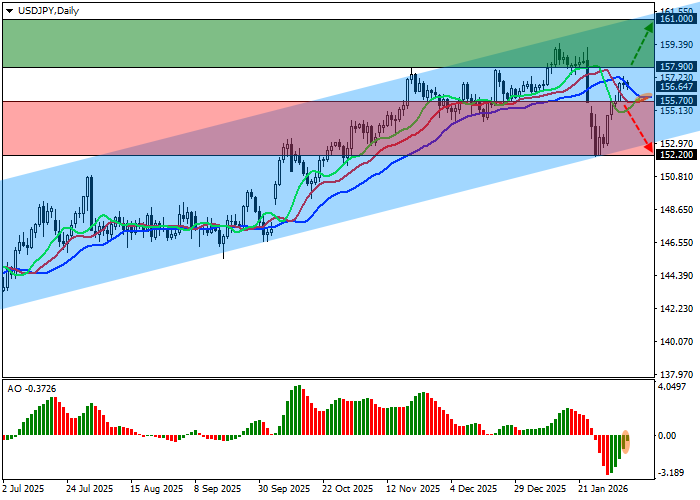
On the daily chart, the instrument is correcting within an upward trend, attempting to approach the resistance line of a long-term ascending channel with boundaries at 161.00–153.00.
Technical indicators have generated a buy signal: the fast EMAs of the Alligator indicator are moving away from the signal line, while the AO histogram is forming corrective bars in the negative zone.
Resistance levels: 157.90, 161.00.
Support levels: 155.70, 152.20.
Trading scenarios and USD/JPY forecast
Long positions can be opened after the price rises and consolidates above 157.90, targeting 161.00. Stop-loss — 157.00. Time horizon: 7 days or more.
Short positions can be opened after the price declines and consolidates below 155.70, targeting 152.20. Stop-loss — 157.00.
Scenario
| Timeframe | Weekly |
| Recommendation | BUY STOP |
| Entry point | 157.95 |
| Take Profit | 161.00 |
| Stop Loss | 157.00 |
| Key levels | 152.20, 155.70, 157.90, 161.00 |
Alternative scenario
| Recommendation | SELL STOP |
| Entry point | 155.65 |
| Take Profit | 152.20 |
| Stop Loss | 157.00 |
| Key levels | 152.20, 155.70, 157.90, 161.00 |