

The situation deteriorated further after the Labour Party suffered a defeat in regional elections in Greater Manchester—an area that had been considered a stable Labour stronghold for more than a century. The loss of control over this region has intensified debate about weakening internal party cohesion, which in turn acts as a catalyst for uncertainty around medium-term fiscal policy parameters, including potential adjustments to the budget deficit, government spending priorities, and the structure of the tax burden. Despite this, equity market dynamics remain largely driven by global macroeconomic factors. The FTSE 100, where more than 70% of corporate revenues are generated outside the UK, continues to demonstrate relative resilience.
A significant share of the index’s capitalization consists of multinational companies in the commodities, energy, and financial sectors, which are more sensitive to global commodity prices and interest-rate dynamics than to domestic political developments. Moreover, a 1.0% depreciation of the pound sterling has historically added around 0.5–0.7 percentage points to the aggregate profits of export-oriented companies when translated into the domestic currency. With the current exchange rate remaining below long-term averages, the currency factor continues to support corporate earnings and dividend yields, which for a number of issuers exceed 4.0–5.0% per annum.
Meanwhile, late last week Rightmove plc announced the launch of a £90.0 million share buyback program following the publication of its 2025 financial results. Revenue increased by 9.0% year-on-year to £425.1 million, compared with £389.9 million a year earlier, broadly in line with consensus forecasts and acting as a catalyst for a roughly 5.0% rise in the company’s shares over subsequent trading sessions. The buyback decision signals stable free cash flow generation and management’s confidence in the sustainability of the operating model, while also supporting earnings per share through a reduced share count. Additional support for the industrial segment came from Senior plc, a manufacturer of aerospace and automotive components, whose shares rose sharply after the company disclosed receiving several preliminary takeover proposals. The potential transactions are reported to involve all-cash consideration, increasing the likelihood of a premium to the market price and boosting interest from institutional investors.
A fairly typical reaction to capital outflows from equities amid heightened geopolitical tensions in the Middle East has been a localized corrective move in the bond market. Short-term one-year gilts are trading at a yield of 3.526%, slightly above 3.486% on Friday, 10-year yields stand at 4.236%, down from 4.306% previously, while more conservative 20-year and 30-year bonds yield 4.917% and 5.042%, compared with 4.964% and 5.079%, respectively.
At present, the top gainers within the index are Diageo Plc (+4.82%), Rightmove plc (+4.34%), BT Group plc (+4.28%), and London Stock Exchange Group plc (+4.24%).
Among the declining stocks are Melrose Industries plc (–11.59%), International Airlines Group SA (–7.35%), Hikma Pharmaceuticals Plc (–4.30%), and Barclays plc (–4.19%).
Support and resistance levels
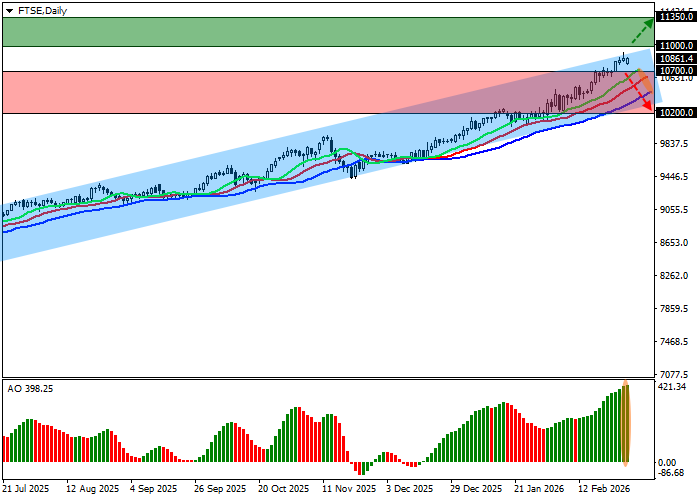
On the daily chart, prices are once again attempting to approach the upper boundary of the 11,000.0–10,100.0 trading channel.
Technical indicators remain in a stable buy-signal configuration, which is strengthening amid the current local correction. The EMA range within the Alligator indicator is gradually expanding, while the Awesome Oscillator histogram is forming new corrective bars above the zero line.
Support levels: 10,700.0, 10,200.0.
Resistance levels: 11,000.0, 11,350.0.
Trading scenarios and FTSE 100 outlook
Long positions may be considered after a sustained move above 11,000.0, with a target at 11,350.0 and a stop-loss at 10,900.0. Time horizon: 7 days or longer.
Short positions may be considered after a sustained move below 10,700.0, with a target at 10,200.0 and a stop-loss at 11,000.0.
Scenario
| Timeframe | Weekly |
| Recommendation | BUY STOP |
| Entry point | 11,000.5 |
| Take Profit | 11,350.0 |
| Stop Loss | 10,900.0 |
| Key levels | 10,200.0, 10,700.0, 11,000.0, 11,350.0 |
Alternative scenario
| Recommendation | SELL STOP |
| Entry point | 10,699.5 |
| Take Profit | 10,200.0 |
| Stop Loss | 11,000.0 |
| Key levels | 10,200.0, 10,700.0, 11,000.0, 11,350.0 |