

Earlier today, Bank of Japan Deputy Governor Ryozo Himino stated that the regulator may continue raising interest rates gradually toward a neutral level. Core inflation could soon reach the 2.0% target, but this does not yet justify abrupt changes in monetary policy. The previous adjustment in borrowing costs has so far had a limited impact on the domestic economy: the output gap remains negative and may only approach zero if a hawkish stance is maintained. Meanwhile, in February, core consumer inflation eased from 2.0% to 1.8% year-on-year versus expectations of 1.7%, while rising by 0.3% month-on-month, raising concerns among policymakers. January industrial production growth accelerated to 2.2%, below expectations of 5.5%. Himino emphasized that further decisions will depend on confirmation of a sustainable inflation trend and faster wage growth, particularly in light of the outcomes of spring wage negotiations between employers and labor unions. Without a sustained rise in nominal incomes, inflation could slip back below target, forcing the central bank to remain cautious.
The US dollar continues the positive trend seen last week, holding near 97.80 on the USDX, as US trading venues remain closed. However, it is already clear that the dollar may struggle to retain its role as a “safe haven,” and volatility is likely to increase once traders receive clearer signals to rotate into other assets. Rising geopolitical tensions in the Middle East and the potential blockage of the Strait of Hormuz—through which around 20.0% of global oil supplies pass—could push crude prices toward the 90.0–100.0 dollar per barrel range or higher. This would intensify inflationary pressure and confront the US Federal Reserve with a difficult choice: either maintain restrictive monetary policy at the cost of economic growth or risk renewed inflation. Uncertainty over future policy decisions is adding to dollar volatility. According to the CME FedWatch Tool, expectations remain unchanged, with a 95.6% probability that rates will be left unchanged at the March meeting.
Support and resistance levels
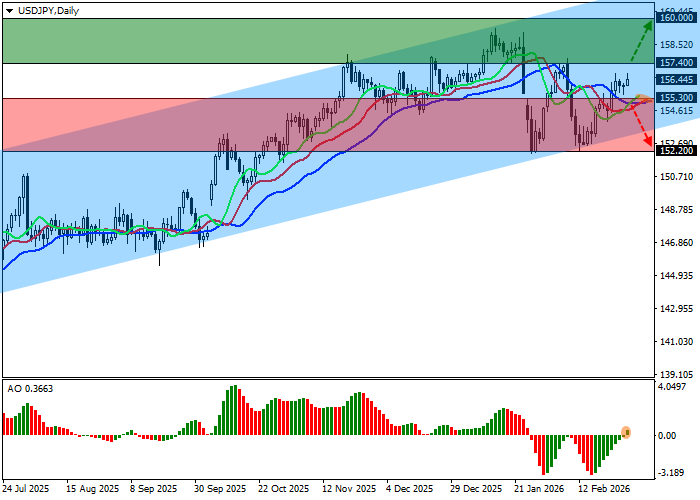
On the daily chart, the pair is correcting within an upward trend, heading toward the resistance line of a broad long-term channel with boundaries at 164.00–153.00.
Technical indicators reinforce an unstable buy signal: the fast EMAs of the Alligator indicator are moving further away from the signal line, while the AO histogram is forming corrective bars in positive territory.
Resistance levels: 157.40, 160.00.
Support levels: 155.30, 152.20.
Trading scenarios and USD/JPY forecast
Long positions can be considered after a sustained breakout above 157.40, with a target at 160.00 and a stop-loss at 156.50. Time horizon: 7 days or longer.
Short positions can be considered after a sustained move below 155.30, with a target at 152.20 and a stop-loss at 156.30.
Scenario
| Timeframe | Weekly |
| Recommendation | BUY STOP |
| Entry point | 157.45 |
| Take Profit | 160.00 |
| Stop Loss | 156.50 |
| Key levels | 152.20, 155.30, 157.40, 160.00 |
Alternative scenario
| Recommendation | SELL STOP |
| Entry point | 155.25 |
| Take Profit | 152.20 |
| Stop Loss | 156.30 |
| Key levels | 152.20, 155.30, 157.40, 160.00 |