

U.S. President Donald Trump announced his readiness to reduce import tariffs from 57.0% to 47.0% in exchange for Beijing’s resumption of U.S. soybean imports, continued exports of rare earth metals, and stricter control over illegal fentanyl trade. The softened rhetoric suggests that crude oil purchases by the world’s largest consumer will continue — a development the White House’s Republican administration is counting on after announcing plans last week to restart oil and gas production in the National Arctic Wildlife Refuge in Alaska, which, according to officials, could meet Asia’s energy demand. The proposal, backed by 52 senators, will soon move to the House of Representatives. According to Trump, the two delegations intend to hold talks soon to discuss cooperation terms in the energy sector.
Meanwhile, investors are focused on the World Bank’s forecast, whose analysts believe that Brent Crude Oil prices will decline from $68.0 to $60.0 per barrel by 2026 — a drop of about 12.0% from current levels and roughly 10.0% on average per year. The projected downturn, they say, will stem from global economic weakness, geopolitical uncertainty, and a growing supply surplus. Extreme weather could further disrupt agricultural production and increase electricity demand for heating and cooling. Notably, early last month Brent futures fell to $64.8 per barrel — a nearly four-month low — after Trump’s announcement of a truce between the Israeli Army and Hamas, sending prices down by 11.0% in just two days to $68.00. Meanwhile, Shell Plc CEO Wael Sawan remains optimistic, suggesting that while global oil oversupply is likely in 2026, longer-term prices may rise as excess supply is partially absorbed by higher Chinese stockpiling.
Late last week, traders also focused on the OPEC+ decision to increase production by 137,000 barrels per day starting in December, compared to the 1.65 million barrels per day cuts announced in April 2023. However, from January to March 2026, output growth will pause due to seasonal factors. The organization’s decision is based on stable global economic prospects and favorable market conditions.
Support and Resistance Levels
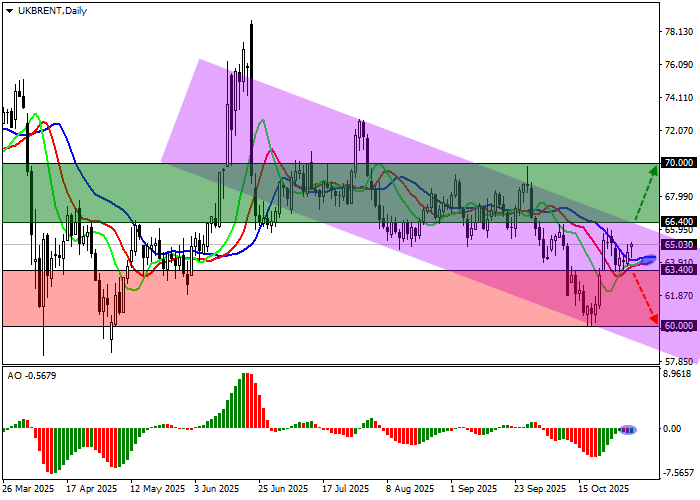
On the daily chart, the price continues to move within a downward channel between 66.00–58.00, forming a new short-term upward wave.
Technical indicators show a weakening sell signal seen earlier last month: fast EMAs on the Alligator indicator remain below the signal line, narrowing their spread, while the AO histogram is forming new descending bars below the zero level.
Support levels: 63.40, 60.00.
Resistance levels: 66.40, 70.00.
Trading Scenarios and Brent Crude Oil Forecast
If the upward movement continues and the price consolidates above 66.40, long positions will remain relevant with a target of 70.00 and a stop loss at 65.00. Implementation time: 7 days or more.
If local declines persist and the price consolidates below 63.40, short positions are relevant with a target of 60.00 and a stop loss at 65.00.
Scenario
| Timeframe | Weekly |
| Recommendation | BUY STOP |
| Entry Point | 66.40 |
| Take Profit | 70.00 |
| Stop Loss | 65.00 |
| Key Levels | 60.00, 63.40, 66.40, 70.00 |
Alternative Scenario
| Recommendation | SELL STOP |
| Entry Point | 63.40 |
| Take Profit | 60.00 |
| Stop Loss | 65.00 |
| Key Levels | 60.00, 63.40, 66.40, 70.00 |
