

The index remains under pressure amid geopolitical tensions in the Persian Gulf region, which continue to be intensified by active operations involving Yemen's Houthi forces. Disruptions to energy supplies have kept the average cost of liquefied natural gas (LNG) for European buyers at elevated levels, equivalent to more than $800.0 per 1,000 cubic metres, while European gas storage facilities are currently around 71.0–72.0% full, significantly below levels typically seen in previous years. In Germany, where fuel consumption is particularly high, underground storage facilities are only around 57.0% full, a historically low level for this time of year that could create additional supply risks during the heating season.
Some support for the stock market comes from expectations surrounding the third-quarter corporate earnings season, which begins to accelerate next week, as well as September business activity data from S&P Global. Germany's Services PMI increased from 49.7 points to 52.9 points, while the Composite PMI rose from 51.8 points to 53.8 points.
Meanwhile, German government bond yields moved higher in the previous session, limiting stronger gains in equities. The benchmark 10-year yield rose toward 3.50%, while the 20-year yield reached around 3.852% and the 30-year yield climbed to approximately 3.866%. Longer-dated yields have eased slightly in early Tuesday trading but remain elevated.
Among the leading DAX 40 gainers in the previous session were Rheinmetall AG (+2.43%), Fresenius Medical Care AG & Co. KGaA (+1.77%), GEA Group AG (+1.58%), Volkswagen AG Vz (+1.57%) and Continental AG (+1.32%).
The biggest declines were recorded by Bayer AG (–2.18%), Heidelberg Materials AG (–1.82%), Infineon Technologies AG (around –1.81%), DHL Group (–1.41%) and HOCHTIEF AG (–1.28%).
As discussed in our previous DAX 40 forecast, elevated energy costs and geopolitical risks remain among the key factors influencing German equities.
Support and resistance levels
On the daily chart, the trading instrument is declining within a corrective trend, moving away from the support line of the global ascending channel with dynamic boundaries of 27500.0–25200.0, which began forming in early March.
Technical indicators are preparing to strengthen the sell signal: the fast EMAs of the Alligator indicator remain below the slow ones, while the AO histogram is forming declining bars in negative territory.
Support levels: 25100.0, 24400.0.
Resistance levels: 25600.0, 26200.0
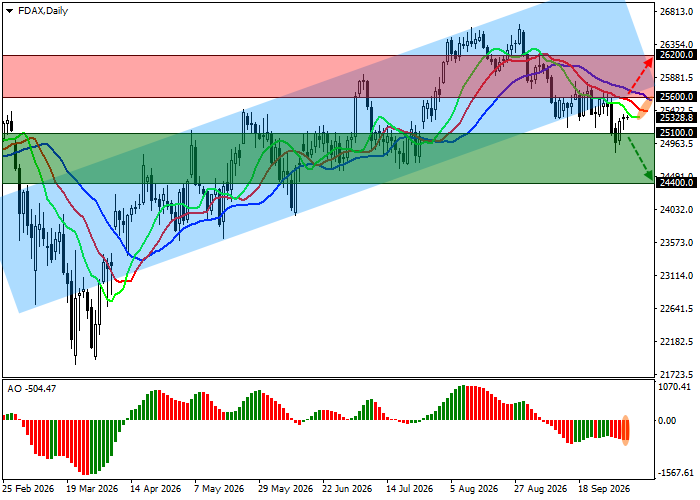
DAX 40 trading scenarios and price forecast
Short positions may be opened after the price declines and consolidates below 25100.0, with a target at 24400.0. Stop-loss — 25500.0. Implementation period: 7 days or more.
Long positions may be opened after the price rises and consolidates above 25600.0, with a target at 26200.0. Stop-loss — 25300.0.
Scenario
| Timeframe | Weekly |
| Recommendation | SELL STOP |
| Entry point | 25100.0 |
| Take Profit | 24400.0 |
| Stop Loss | 25500.0 |
| Key levels | 24400.0, 25100.0, 25600.0, 26200.0 |
Alternative scenario
| Recommendation | BUY STOP |
| Entry point | 25600.0 |
| Take Profit | 26200.0 |
| Stop Loss | 25300.0 |
| Key levels | 24400.0, 25100.0, 25600.0, 26200.0 |
