

Analysts, however, suggest this aggressive US policy shift is unlikely to dent India’s oil procurement volumes. Roughly 60% of Indian crude imports—mainly medium-sour grades—are sourced from countries like Russia. Despite the Ukraine conflict, total imports have held steady at 2.5–2.8 million barrels per day (bpd), while domestic demand has surged by 1.0 million bpd to 5.5 million bpd. With India’s own production declining, net imports are projected to reach 5.0 million bpd soon, rising to as much as 5.8 million bpd by 2030. In response, India’s Ministry of External Affairs has stressed that the government will take all necessary steps to safeguard national interests and economic security.
 WTI oil price volatility after US tariffs on India
Notably, India is far from the only buyer of Russian commodities. The EU continues to import Russian fertilizers and metals, while the US itself remains a customer for certain chemicals and uranium derivatives.
Meanwhile, OPEC+ production is poised to increase by 502,000 bpd in August, bringing total output to 37.03 million bpd and partially compensating for previous shortfalls. In 2023, the eight largest oil producers implemented a voluntary cut of 2.2 million bpd, but the group now aims to boost output by 548,000 bpd. Despite these targets, actual output has frequently exceeded quotas, with Kazakhstan alone producing 480,000 bpd above its cap in June. Underproduction in Mexico, Azerbaijan, and Malaysia offset this surplus, keeping the group’s total output just 11,000 bpd below target last month.
The latest US Energy Information Administration (EIA) data revealed that commercial crude inventories fell by 3.03 million barrels to 423.7 million last week. Gasoline stocks dropped by 1.32 million barrels to 234.49 million, while distillates declined by 570,000 barrels to 113.29 million. Earlier, API reported a larger-than-expected drawdown of 4.2 million barrels, far exceeding analyst estimates of -1.8 million barrels.
Technical Analysis: Key Support and Resistance Levels
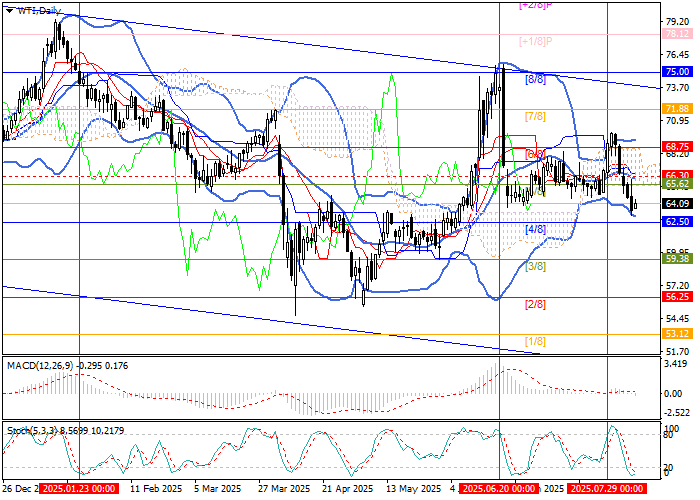
Last week, WTI futures tested six-week highs near $70.00 before resuming their decline, now approaching critical support at $62.50 (Murray [4/8]). A breakdown below this level would open downside targets at $59.38 (Murray [3/8]) and $56.25 (Murray [2/8]). For bulls, the primary resistance is found in the $66.30–$65.62 area (mid-Bollinger Band, Murray [5/8]). A sustained move above this range could trigger rallies toward $68.75 (Murray [6/8]) and $71.88 (Murray [7/8]), the upper boundary of the descending channel.
- Resistance: $66.30, $68.75, $71.88
- Support: $62.50, $59.38, $56.25
Technical indicators are mixed: Bollinger Bands are turning lower, MACD has crossed into negative territory, but Stochastic is in oversold and may soon reverse higher.
Trading Scenarios
- Sell stop: Below $62.50, targeting $59.38 and $56.25. Stop loss: $64.70. Time frame: 5–7 days.
- Buy stop: Above $66.30, targeting $68.75 and $71.88. Stop loss: $64.40.
Summary: WTI crude oil faces pressure amid escalating US-India trade tensions and volatile global supply dynamics. Traders should monitor key support at $62.50 and resistance at $66.30 for potential breakout signals. Inventory data and OPEC+ output trends remain critical for short-term price action.
