
The US dollar is under pressure following yesterday’s labour market data, which showed that non-farm payrolls increased by only 57.0 thousand, compared with expectations of 110.0 thousand, while unemployment declined from 4.3% to 4.2%. This significantly reduced the likelihood of an interest-rate hike in the near future, although inflation in the country remains well above the 2.0% target. At its June meeting, the regulator kept borrowing costs within the 3.50–3.75% range, supporting the currency through high yields. However, the Consumer Price Index, which reached 4.2% year-on-year in May, and the Personal Consumption Expenditures Price Index at 4.1% continue to weigh on the economy, limiting officials’ hawkish rhetoric.
Meanwhile, in the EU, the June Harmonised Index of Consumer Prices declined from 3.2% to 2.8% year-on-year, significantly below analysts’ consensus forecast of 3.0%. The core indicator, excluding food and energy, slowed from 2.6% to 2.4%, compared with expectations of 2.6%. This was primarily driven by lower fuel prices: annual growth in the energy component slowed from 10.8% to 8.7% amid progress in US-Iran peace talks and the reopening of the Strait of Hormuz. Inflation in the services sector eased from 3.5% to 3.2%, while prices for food, alcohol and tobacco slowed from 1.9% to 1.6%.
On the one hand, this trend reduces hawkish pressure on the regulator, limiting the upside potential of the single currency. On the other hand, markets have already priced in a significant part of the adjustment in borrowing conditions and estimate the probability of a 25-basis-point interest-rate hike at the September meeting at 50.0%.
Thus, EUR/USD is supported by the ECB’s more restrictive stance and deteriorating expectations for the US dollar following cooling in the American employment sector. However, the weak eurozone economy and persistently high US inflation do not allow the trend to reverse.
Support and resistance levels
The long-term trend remains downward. However, at the end of last month, the instrument tested the 1.1400 support level. A breakout below this level could lead to a decline toward 1.1080. Otherwise, long positions may be considered from this level with targets at 1.1616 and 1.1788.
Within the medium-term downward trend, quotations broke below Zone 2 (1.1441–1.1421) last week and headed toward Zone 3 (1.1249–1.1229). At the moment, however, the pair is correcting upward and may reach the trend resistance area of 1.1535–1.1516, near which short positions may become relevant with targets at 1.1429 and 1.1324.
Resistance levels: 1.1616, 1.1788.
Support levels: 1.1400, 1.1080.
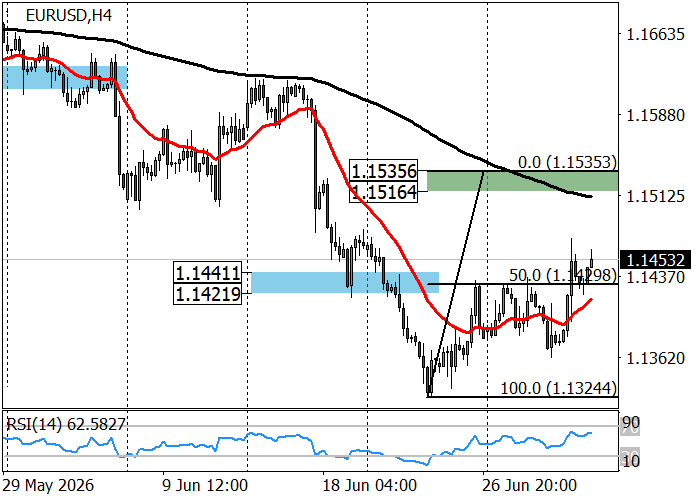
EUR/USD Trading Scenarios and Price Forecast
Long positions may be opened from the 1.1400 level with a target at 1.1616 and a stop-loss at 1.1327. Expected implementation period: 9–12 days.
Short positions may be opened below the 1.1327 level with a target at 1.1080 and a stop-loss at 1.1443.
Scenario
| Timeframe | Weekly |
| Recommendation | BUY LIMIT |
| Entry point | 1.1405 |
| Take Profit | 1.1616 |
| Stop Loss | 1.1327 |
| Key levels | 1.1080, 1.1400, 1.1616, 1.1788 |
Alternative Scenario
| Recommendation | SELL STOP |
| Entry point | 1.1325 |
| Take Profit | 1.1080 |
| Stop Loss | 1.1443 |
| Key levels | 1.1080, 1.1400, 1.1616, 1.1788 |
