
The escalation of the conflict continues, prompting investors to fear a deeper global recession and favor the dollar over alternative currencies. At the same time, conflicting signals are coming from Washington and Tehran. According to The Wall Street Journal, US President Donald Trump discussed with his advisers the possibility of ending the operation, as forcing the Islamic Republic to unblock the Strait of Hormuz could intensify the negative impact on the global economy.
On the other hand, the head of the White House said he intends to destroy all of Iran’s energy and oil-production infrastructure if traffic through the waterway is not restored. Analysts note that in this case, the collateral damage to the region’s industrial and logistics infrastructure would be enormous, which would further lift oil prices and accelerate consumer inflation. As a result, the US Federal Reserve could shift toward keeping interest rates unchanged or even tightening monetary policy by the end of the year.
Nevertheless, Federal Reserve Chair Jerome Powell, speaking at Harvard University, said that inflation expectations remain stable and there is currently no need to raise borrowing costs. He also added that changes in credit conditions affect the economy with a lag and would not quickly soften the consequences of the war with Iran. Some analysts believe Powell’s optimism, ahead of his resignation in May, may prove unjustified: even before the conflict escalated, consumer prices had remained consistently above the 2.0% target, with annual inflation at 2.4% in February and the core indicator at 2.5%. Moreover, over the past month, gasoline prices have risen by 30.0% to $4.0 per gallon, while diesel prices have climbed by 40.0% to $5.0 per gallon, levels not seen since the start of the Russia-Ukraine conflict in 2022. At the same time, Chinese manufacturers actively exporting to the United States have openly stated that rising energy costs are forcing them to pass those expenses on to consumers, raising product prices by as much as 20.0% in some cases. This increases the likelihood of tighter monetary policy by year-end, further strengthening the dollar.
The euro remains under pressure after the release of Germany’s February retail sales data, which fell by 0.6% month-over-month instead of the expected 0.3% increase, while annual growth came in at 0.7% versus forecasts of 1.0%. Overall, Germany’s industrial sector remains under pressure from higher US trade tariffs and rising fuel costs. The European Central Bank’s monetary policy is likely to remain unchanged in the near term, though tightening remains possible. According to preliminary March data published today, the consumer price index rose from 1.9% to 2.5% year-over-year versus expectations of 2.6%, while the core indicator slowed to 2.3% against forecasts of 2.4%.
Overall, fundamental factors continue to support further downside in EUR/USD.
Support and resistance levels
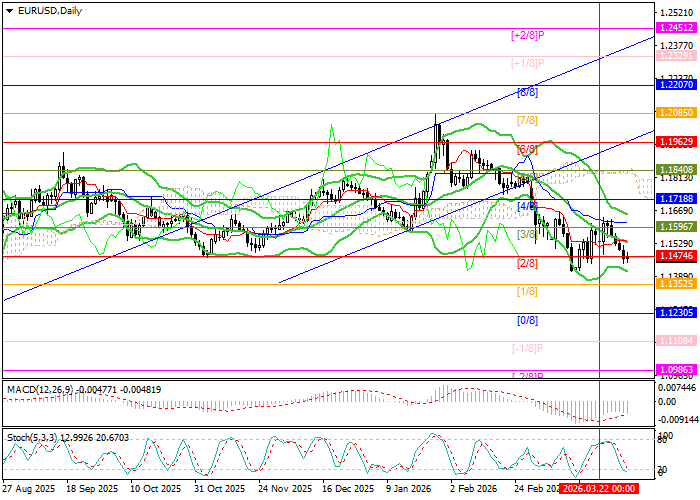
A bearish trend is forming in the market, and prices are attempting to consolidate below 1.1474 (Murrey [2/8]), after which a decline toward 1.1230 (Murrey [0/8]) and 1.1108 (Murrey [–1/8]) is expected. However, if the pair breaks above 1.1718 (Murrey [4/8]), which lies above the Bollinger Bands midline, bullish momentum may continue toward 1.1962 (Murrey [6/8]) and 1.2207 (Murrey [8/8]).
Technical indicators maintain a sell signal: Bollinger Bands are turning downward, the MACD histogram is expanding in negative territory, while Stochastic has reached the oversold zone, which does not rule out a limited corrective rebound.
Resistance levels: 1.1718, 1.1962, 1.2207.
Support levels: 1.1474, 1.1230, 1.1108.
Trading scenarios and EUR/USD forecast
Short positions may be opened below 1.1474 with targets at 1.1230 and 1.1108 and a stop-loss at 1.1600. Implementation period: 5–7 days.
Long positions may be opened above 1.1718 with targets at 1.1962 and 1.2207 and a stop-loss at 1.1580.
Scenario
| Timeframe | Weekly |
| Recommendation | SELL |
| Entry point | 1.1465 |
| Take Profit | 1.1230, 1.1108 |
| Stop Loss | 1.1600 |
| Key levels | 1.1108, 1.1230, 1.1474, 1.1718, 1.1962, 1.2207 |
Alternative scenario
| Recommendation | BUY STOP |
| Entry point | 1.1720 |
| Take Profit | 1.1962, 1.2207 |
| Stop Loss | 1.1580 |
| Key levels | 1.1108, 1.1230, 1.1474, 1.1718, 1.1962, 1.2207 |
