

The US dollar is receiving support from macroeconomic data released yesterday: the October Consumer Confidence Index rose from 84.2 points to 91.7 points, reaching its highest level since May, instead of the expected decline to 81.2 points. Durable Goods Orders increased by 1.8% in September, slightly below the forecast of 2.0% but significantly above August's growth of 0.1%, while New Home Sales reached 676.0K, exceeding the expected 651.0K. These figures confirm the resilience of the US economy even amid the ongoing crisis, allowing the US Federal Reserve to focus on combating inflation. The results of today's meeting will be announced at 19:30 (GMT+2): the interest rate is expected to remain unchanged at 4.00%, so investors will focus primarily on signals regarding the regulator's future actions. Most likely, members of the Federal Open Market Committee (FOMC) will not specify the timing of the next interest rate adjustment but may hint at the possibility of a rate hike in December, the probability of which is estimated at 84.1%, according to the Chicago Mercantile Exchange (CME) FedWatch Tool.
The pound remains under pressure as traders await the announcement of the new government budget by UK Chancellor of the Exchequer John Healey today. Most experts expect the Treasury to announce tax increases for banks, gambling companies, and online marketplaces, which would help finance government support for low-income households facing high electricity prices while maintaining the current fuel duty for motorists. In addition, the document is expected to outline how the government plans to give regional leaders in the UK greater control over tax revenues as part of Prime Minister Burnham's efforts to decentralise power. The government is also likely to announce the allocation of more than 20.0 billion pounds to public financial institutions to stimulate investment in artificial intelligence, defence, and green energy.
Support and resistance levels
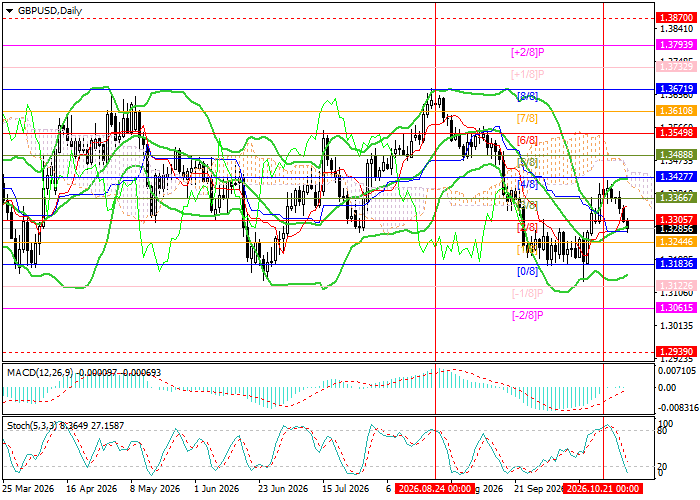
The trading instrument is moving within a wide sideways range of 1.3183–1.3671 (Murrey levels [0/8]–[8/8]), formed at the end of last year. The quotes have resumed their decline and are testing the middle line of the Bollinger Bands around 1.3290. A consolidation below this level is expected to lead to the targets of 1.3183 (Murrey level [0/8]), 1.3061 (Murrey level [–2/8]), and 1.2939 (Murrey level [2/8], W1). However, if the price breaks above 1.3427 (Murrey level [4/8], upper line of the Bollinger Bands, W1), a return to the upper boundary of the sideways range at 1.3671 (Murrey level [8/8]) and further growth towards 1.3793 (Murrey level [+2/8]) and 1.3870 (yearly high) are expected.
Technical indicators do not provide a clear signal: the Bollinger Bands are turning upwards, the MACD histogram has moved into positive territory, but its values remain insignificant, while the Stochastic oscillator is pointing downwards.
Resistance levels: 1.3427, 1.3671, 1.3793, 1.3870.
Support levels: 1.3290, 1.3183, 1.3061, 1.2939.
Trading scenarios and GBP/USD forecast
Short positions can be opened below 1.3183 with targets at 1.3061 and 1.2939 and a stop-loss at 1.3270. Implementation period: 5–7 days.
Long positions can be opened above 1.3427 with targets at 1.3671, 1.3793, 1.3870 and a stop-loss at 1.3330.
Scenario
| Timeframe | Weekly |
| Recommendation | SELL STOP |
| Entry Point | 1.3183 |
| Take Profit | 1.3061, 1.2939 |
| Stop Loss | 1.3270 |
| Key Levels | 1.2939, 1.3061, 1.3183, 1.3290, 1.3427, 1.3671, 1.3793, 1.3870 |
Alternative Scenario
| Recommendation | BUY STOP |
| Entry Point | 1.3427 |
| Take Profit | 1.3671, 1.3793, 1.3870 |
| Stop Loss | 1.3330 |
| Key Levels | 1.2939, 1.3061, 1.3183, 1.3290, 1.3427, 1.3671, 1.3793, 1.3870 |
