
This week, the Swiss Federal Statistical Office published updated Producer Price Index data: in April, the reading rose 0.8% month-on-month to 100.5 points, driven primarily by higher prices for petroleum products, crude oil, and natural gas, while in annual terms the indicator continues to show deflationary dynamics, declining 2.0%. This structure points to persistent pressure from external demand and subdued EU industrial sector activity, despite localized growth in commodity components. Within the import price index, the most notable price increases were also recorded in petroleum products, crude oil, natural gas, industrial metals, and semi-finished goods. Price increases were also observed in computer hardware and peripheral devices — potentially reflecting ongoing cost pressures in the technology sector and supply chains — while deflationary pressure was evident in medical and dental equipment, as well as furniture and industrial machinery.
As for the US dollar, it is currently holding near 98.9 on the USDX, displaying moderate bullish momentum. The greenback has drawn support from a recovery in safe-haven demand against the backdrop of President Donald Trump's visit to China. The shift in focus from Middle Eastern geopolitical tensions to the US–China negotiating track has temporarily reduced the level of global uncertainty in commodity markets, allowing the dollar to modestly strengthen against its main rivals. An additional factor has been a reassessment of future Fed monetary policy.
The Senate confirmed Kevin Warsh as the next Fed Chair — to succeed Jerome Powell upon the expiry of his term — by 54 votes to 45. Investors interpreted the decision as a signal of a potential policy shift toward a more accommodative approach. Trump has repeatedly criticized the Fed's leadership, calling for consistent rate cuts to stimulate the economy and reduce the federal budget's debt burden. The rate currently sits in the 3.50–3.75% range, but futures markets are gradually beginning to price in the possibility of earlier easing should weak macroeconomic data emerge. According to the CME FedWatch Tool, the first rate change is not expected before September, which continues to give the dollar a yield advantage over most G10 currencies. Nevertheless, its further trajectory will depend directly on inflation indicators and the state of the US labor market: the latest data showed initial jobless claims rising to 211,000 from 199,000 the previous week.
Support and Resistance Levels
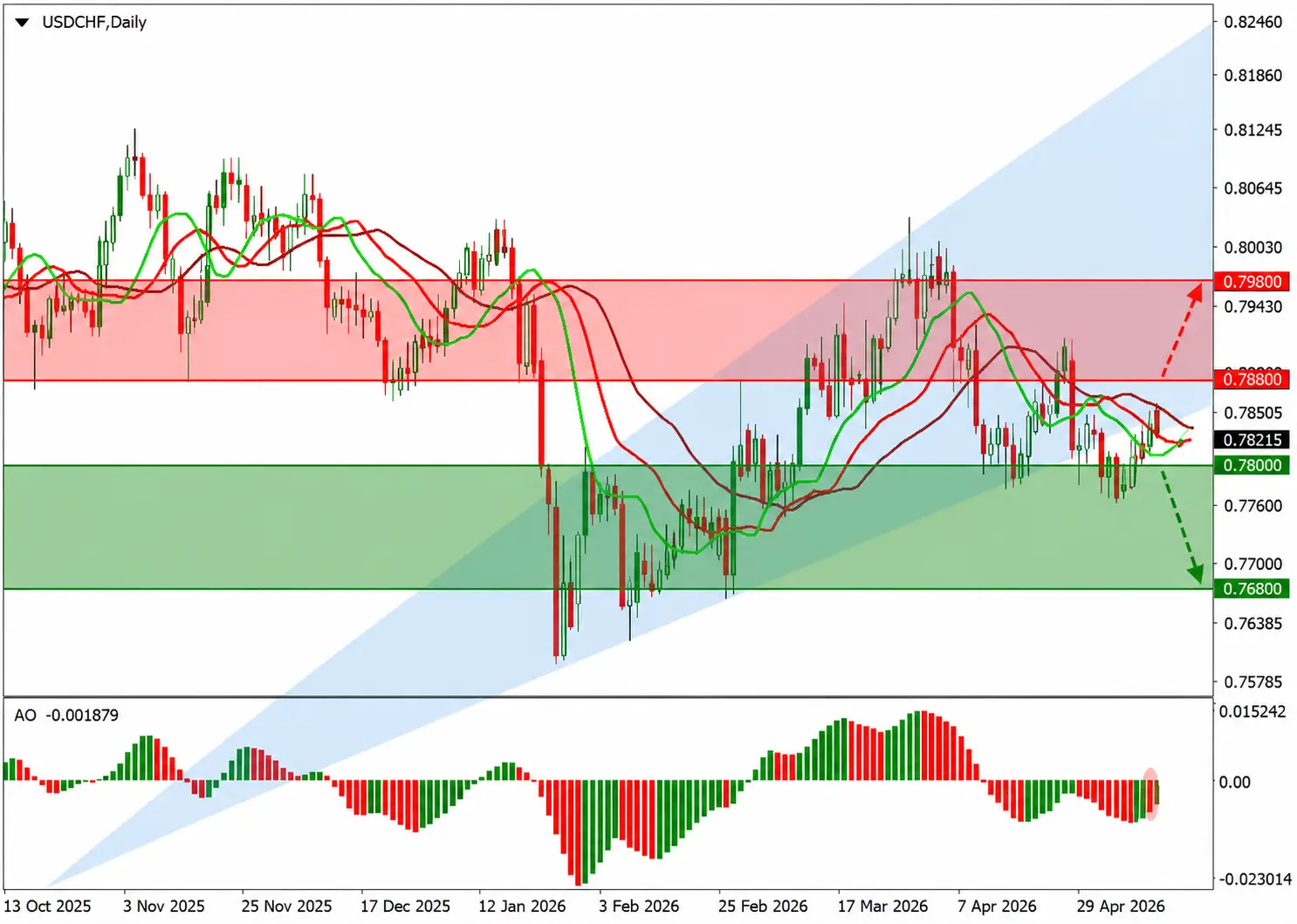
On the daily chart, the pair is trading below the support line of the ascending broadening formation pattern, with dynamic boundaries at 0.8000–0.7800.
Technical indicators reversed course at the start of the month and are still holding a sell signal: the Alligator's fast EMAs are well below the signal line and gradually moving further away from it, while the Awesome Oscillator histogram remains below the zero line, forming new corrective bars there.
Support levels: 0.7800, 0.7680.
Resistance levels: 0.7880, 0.7980.
USD/CHF Trading Scenarios and Price Forecast
Short positions can be opened after the price declines and consolidates below 0.7800, targeting 0.7680, with a stop-loss at 0.7870. Time horizon: 7 days or more.
Long positions can be opened after the price rises and consolidates above 0.7880, targeting 0.7980, with a stop-loss at 0.7810.
| Scenario | |
|---|---|
| Timeframe | Weekly |
| Recommendation | SELL STOP |
| Entry Point | 0.7795 |
| Take Profit | 0.7680 |
| Stop Loss | 0.7870 |
| Key Levels | 0.7680, 0.7800, 0.7880, 0.7980 |
| Alternative Scenario | |
|---|---|
| Recommendation | BUY STOP |
| Entry Point | 0.7885 |
| Take Profit | 0.7980 |
| Stop Loss | 0.7810 |
| Key Levels | 0.7680, 0.7800, 0.7880, 0.7980 |
