
Where investors had previously expected incoming Fed Chair Kevin Warsh — who takes office on Friday — to actively promote dovish sentiment among his colleagues, this now appears less likely. April data showed the Consumer Price Index rising from 3.3% to a three-year high of 3.8% year-on-year, exceeding the 3.7% forecast, while the core reading climbed from 2.6% to 2.8% against an expected 2.7%. The Producer Price Index rose from 4.3% to 6.0%, with the core measure up from 4.0% to 5.2%, while the labor market remains resilient. Under the Fed's dual mandate, officials may now pivot toward fighting inflation — implying that the current monetary policy stance will be maintained for an extended period or even tightened later in the year. On Wednesday at 20:00 (GMT+2), the minutes of the Fed's last meeting will be released, and traders will be looking for board members' views on the economic situation as well as any signals regarding the timing of the next rate adjustment.
Additional support for the dollar as a traditional safe-haven asset is coming from President Trump's aggressive rhetoric: over the weekend he reminded Iran that the clock is ticking on a conflict resolution decision, warning that the Islamic Republic would face destruction if it refuses to accept US terms. As on the previous occasion, the White House leader subsequently temporarily suspended the resumption of full-scale military operations following requests from allied Gulf states — a development that triggered a modest correction in the dollar.
The Swiss franc's upside potential has not yet been exhausted, though this scenario does not currently appear to be investors' priority. Switzerland's Consumer Price Index rose from 0.3% to 0.6%, while the Producer Price Index improved from –2.7% to –2.0% year-on-year. Inflationary pressure remains within the Swiss National Bank's target range of 0.0–2.0%, but a further rise in the indicator would necessitate higher borrowing costs — a scenario that SNB Governor Martin Schlegel has already flagged as a possibility.
Support and Resistance Levels
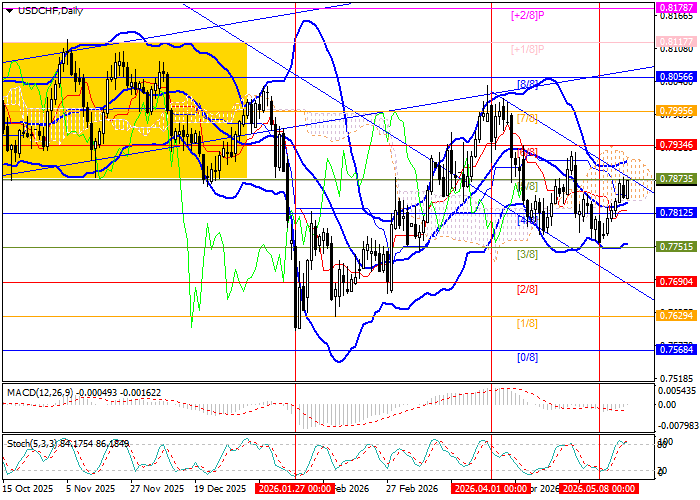
The pair has consolidated above the Bollinger Bands middle line and is approaching 0.7873 (Murray [5/8]): a breakout above this level is expected to push price out of the descending channel and continue higher toward 0.7995 (Murray [7/8]) and 0.8056 (Murray [8/8]), while a downside break of 0.7751 (Murray [3/8]) would open the way toward 0.7690 (Murray [2/8]), 0.7629 (Murray [1/8]), and 0.7568 (Murray [0/8]).
Technical indicators are sending mixed signals: the Bollinger Bands are turning upward, the MACD histogram is preparing to cross into positive territory, though the Stochastic may exit overbought territory in the near term.
Resistance levels: 0.7873, 0.7995, 0.8056.
Support levels: 0.7751, 0.7690, 0.7629, 0.7568.
USD/CHF Trading Scenarios and Price Forecast
Long positions can be opened above 0.7873, targeting 0.7995 and 0.8056, with a stop-loss at 0.7810. Time horizon: 5–7 days.
Short positions can be opened below 0.7751, targeting 0.7690, 0.7629, and 0.7568, with a stop-loss at 0.7795.
| Scenario | |
|---|---|
| Timeframe | Weekly |
| Recommendation | BUY STOP |
| Entry Point | 0.7875 |
| Take Profit | 0.7995, 0.8056 |
| Stop Loss | 0.7810 |
| Key Levels | 0.7568, 0.7629, 0.7690, 0.7751, 0.7873, 0.7995, 0.8056 |
| Alternative Scenario | |
|---|---|
| Recommendation | SELL STOP |
| Entry Point | 0.7750 |
| Take Profit | 0.7690, 0.7629, 0.7568 |
| Stop Loss | 0.7795 |
| Key Levels | 0.7568, 0.7629, 0.7690, 0.7751, 0.7873, 0.7995, 0.8056 |
