

Seven members of the policy board voted to maintain the current monetary stance, while Naoki Tamura and Hajime Takata supported a 25-basis-point rate hike. The regulator noted that U.S. tariff-related uncertainty had eased following the July trade deal between Japan and the United States but warned that risks persist. The BoJ also kept its inflation outlook unchanged for the current and the next two fiscal years. According to the latest report, core consumer prices (excluding fresh food) are expected to rise by 2.7% in the fiscal year ending March 2026, by 1.8% in the following year, and by 2.0% in the year ending March 2028.
Markets now expect a more hawkish tone at the upcoming meetings once global trade volatility stabilizes. However, any policy tightening is likely to be gradual, as the central bank remains cautious — a stance criticized by U.S. officials. U.S. Treasury Secretary Scott Bessent recently rebuked Japanese Finance Minister Satsuki Katayama for the yen’s persistent weakness, emphasizing that effective communication and consistent monetary policy are essential to curb inflation expectations and prevent excessive exchange-rate volatility. Earlier, U.S. President Donald Trump had also accused Japan of gaining an “unfair trade advantage” through a weaker currency.
The BoJ’s decision followed the U.S. Federal Reserve’s move to cut its target rate to 3.75–4.00%, as policymakers judged that risks to growth now outweigh inflation concerns. The U.S. dollar strengthened after Fed Chair Jerome Powell stated that another rate adjustment in December was “not guaranteed.” Powell noted that the lack of key labor market data, caused by the ongoing government shutdown, and increasing divisions within the FOMC make consensus difficult. Fed Governor Steven Miran once again advocated a deeper rate cut, while Kansas City Fed President Jeffrey Schmid argued for keeping rates unchanged due to lingering inflation pressures. According to a Bloomberg survey conducted among 50 economists between October 16 and 22, only five expected a rate hike at the end of the two-day meeting that concluded Thursday.
Support and Resistance Levels
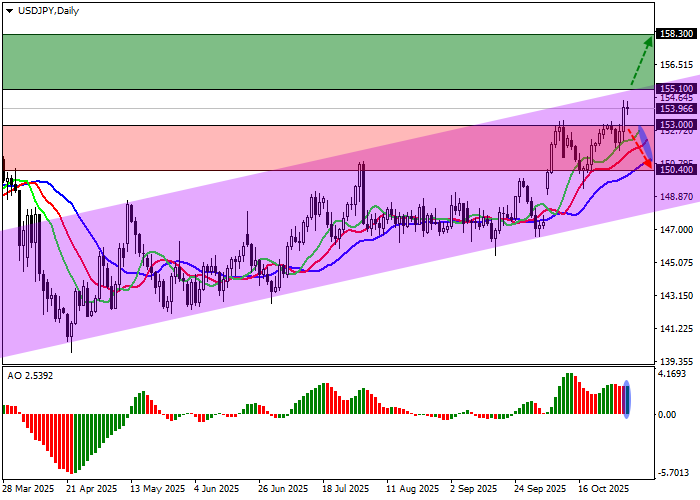
On the daily chart, the price remains within an ascending channel between 156.00 and 148.00, approaching the upper resistance boundary.
Technical indicators confirm a strengthening buy signal: the fast EMAs of the Alligator indicator are widening again from the signal line, while the Awesome Oscillator in the positive zone is forming fresh bullish bars.
Support levels: 153.00, 150.40.
Resistance levels: 155.10, 158.30.
USD/JPY Trading Scenarios and Forecast
Long positions may be opened after a breakout above 155.10 with a target at 158.30 and a stop-loss at 154.00. Expected horizon: 7 days or more.
Short positions may be considered after a move below 153.00, targeting 150.40, with a stop-loss at 154.00.
Scenario
| Timeframe | Weekly |
| Recommendation | BUY STOP |
| Entry Point | 155.10 |
| Take Profit | 158.30 |
| Stop Loss | 154.00 |
| Key Levels | 150.40, 153.00, 155.10, 158.30 |
Alternative Scenario
| Recommendation | SELL STOP |
| Entry Point | 153.00 |
| Take Profit | 150.40 |
| Stop Loss | 154.00 |
| Key Levels | 150.40, 153.00, 155.10, 158.30 |
