

As for the domestic backdrop, the yen remains under significant pressure from mixed signals regarding future monetary policy. Whereas the probability of an interest rate hike at the April meeting had previously been estimated at 60.0–70.0% according to the OIS curve, the figure dropped below 40.0% after the release of the updated International Monetary Fund (IMF) World Economic Outlook report and the meetings held within the G7 and G20 frameworks.
The adjustment in expectations is linked to a growing consensus among developed economies in favor of maintaining a wait-and-see stance amid uncertainty caused by the escalation of the Middle East crisis and rising inflation pressures. It should be recalled that the global growth forecast for 2026 was revised down by 0.2 percentage points, from 3.3% to 3.1%, compared with 3.4% in 2025, while the projection for the following year remained unchanged at 3.2%. For Japan, the forecast stands at 0.7% and 0.6%, respectively. At the same time, the absence of signals from Bank of Japan Governor Kazuo Ueda about changes in monetary conditions at the upcoming April 27–28 meeting was interpreted in his latest speech as a sign of a pause in the hawkish cycle.
At the same time, the regulator is considering a substantial upward revision of inflation forecasts for the current fiscal year amid a sharp increase in energy prices caused by geopolitical instability in the Middle East, which is intensifying imported inflation in an economy critically dependent on external raw material supplies. According to the regulator’s January estimate, the core indicator excluding fresh food for fiscal 2026 was projected at 1.9%, but the current “energy shock” clearly points to an overshoot of that benchmark and the emergence of a more persistent inflation trend. Nevertheless, according to the results of the regulator’s quarterly household survey, the share of families expecting consumer prices to rise over the next year declined from 86.0% to 83.7%, while over the five-year horizon it fell from 83.0% to 82.6%. On average, in the latter case, respondents expect an acceleration of 10.3%, the highest level since records began in 2006.
As for the US dollar, the USDX remains near 97.9 points, in close proximity to its lowest level in the past four weeks. Pressure on the index intensified following a reassessment of market expectations regarding a possible peace agreement between the United States and Iran. Escalating tensions in the Persian Gulf and the broader Middle East, including the detention of the Iranian merchant vessel Touska by naval forces and the subsequent retaliatory drone strike on US military facilities, have sharply reduced the likelihood of the two sides returning to negotiations, a view also confirmed by Iranian Deputy Foreign Minister Saeed Khatibzadeh. According to him, official Tehran rejected the Republican administration’s demand to place around 440.0 kg of enriched uranium under international control, calling the condition unacceptable from the standpoint of nuclear sovereignty. At the same time, the Iranian authorities are insisting on an expanded ceasefire framework that would also include Lebanon, while blaming the escalation on the United States and Israel because of the ongoing strikes on Beirut. Another key structural factor is sovereignty over the Strait of Hormuz: refusal to reopen it temporarily is being accompanied by plans to implement a new security protocol that would tie freedom of navigation to the full lifting of sanctions pressure and the end of the maritime blockade.
Support and resistance levels
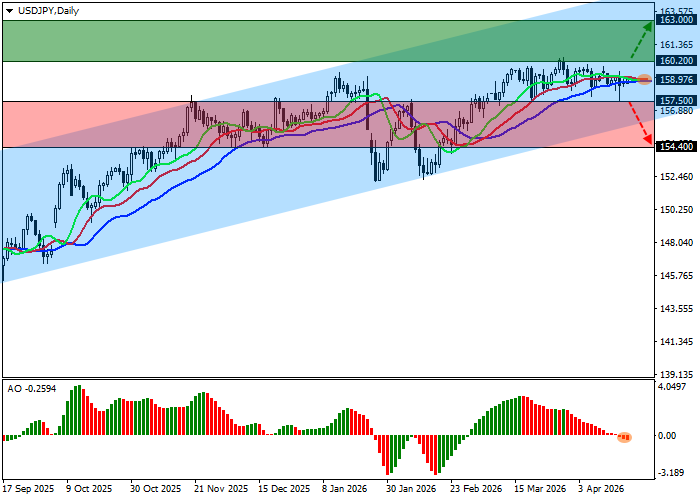
On the daily chart, the instrument is correcting within an upward trend, attempting to move away from the global resistance line of the broad long-term channel at 164.00–154.00.
Technical indicators have almost fully reversed and generated a fresh sell signal that is ready to strengthen amid the local correction: the fast EMAs on the Alligator indicator are positioned near the signal line, while the AO histogram is forming new corrective bars above the transition level.
Support levels: 157.50, 154.40.
Resistance levels: 160.20, 163.00.
Trading scenarios and USD/JPY forecast
Short positions may be opened after the price consolidates below 157.50 with a target at 154.40. Stop-loss: 158.50. Timeframe: 7 days or more.
Long positions may be opened after the price consolidates above 160.20 with a target at 163.00. Stop-loss: 159.00.
Scenario
| Timeframe | Weekly |
| Recommendation | SELL STOP |
| Entry Point | 157.45 |
| Take Profit | 154.40 |
| Stop Loss | 158.50 |
| Key Levels | 154.40, 157.50, 160.20, 163.00 |
Alternative Scenario
| Recommendation | BUY STOP |
| Entry Point | 160.25 |
| Take Profit | 163.00 |
| Stop Loss | 159.00 |
| Key Levels | 154.40, 157.50, 160.20, 163.00 |
